
“They kept demanding an answer, so he stood up again and said, ‘All right, hurl the stones at her until she dies. But only he who never sinned may throw the first!’” – John 8:7
Thanks to the Winter Olympics, I’ve got stone throwing on my mind.
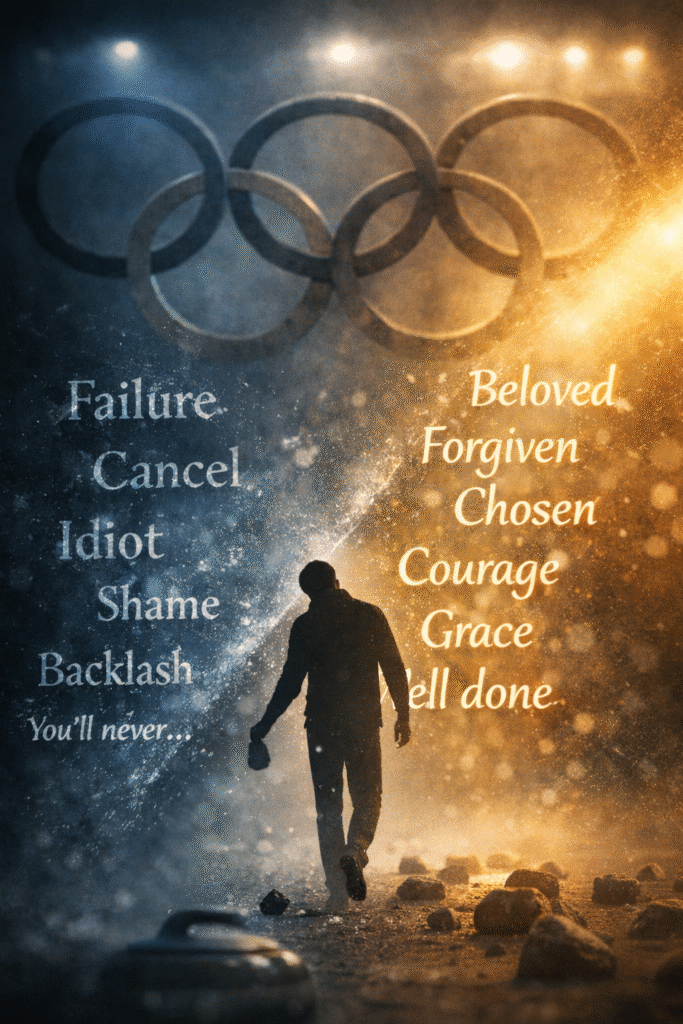
Every four years we are reintroduced to the sport of curling, where athletes slide 44-pound granite stones toward a target 126 feet away. The player creates a curved trajectory—known as the “curl”—by gently rotating the stone as it leaves the hand. For a sport dating back to 16th-century Scotland, it still hasn’t found massive appeal. At least the Scots have golf.
Unfortunately, the sport of hurling insults, condemnation, and criticism has found mass appeal.
Judging by the national mood, there is huge demand for it. I call it a “sport” because the words we throw at one another feel like a competition—opposing teams fighting for the illusion of supremacy … the last word, the win. Ironically, there are no winners, no gain, and everyone loses.
Every day headlines feature words like battle, rip, backlash, slam, accuse, revenge. And that’s just ESPN. The fiercest hurling is usually saved for the front and opinion pages.
Remember when we used to say, “Sticks and stones can break my bones, but words can never harm me”?
It was playground armor. Say it fast enough and confidently enough, and maybe you’d convince yourself the sting didn’t land.
But here’s the thing.
It’s catchy.
It’s punchy.
It’s not true.
Modern psychology and ancient Scripture agree: words absolutely harm.
Neuroscience shows that verbal rejection activates the same pain centers in the brain as physical injury. Long before brain scans, Proverbs told us, “The tongue has the power of life and death” (Prov. 18:21). James compares it to a spark that can set a forest ablaze (James 3).
And Jesus raises the stakes even higher. In Matthew 12:36, He says we will give account for every careless word. That isn’t meant to silence us. It’s meant to awaken us to influence.
When the Pharisees dragged the woman caught in adultery before Him, they were hurling more than stones. They were hurling accusation, condemnation, and hypocrisy. The prescribed punishment was death by stoning. Seeing what they could not see in themselves, Jesus invited anyone without sin to throw first.
One by one, beginning with the oldest, they dropped their rocks and walked away.
Words can wound.
But they can also heal.
They build.
They commission.
They restore.
They declare ground taken or surrendered.
Run the play.
Drop the rocks.
Let’s hurl words that create life.
Now that’s an Olympic sport we can all pick up and play.
Finding Our Place in the Story
Where in my life am I tempted to hurl criticism, sarcasm, or condemnation instead of extending mercy and truth?
- Is there a relationship where I keep reaching for a stone?
If my words over the past week were replayed publicly, would they create life or quietly chip away at it?
- Where might the Lord be inviting me to use my voice to heal, build, or restore instead?
What kind of “sport” are we modeling as a church — one of hurling or one of healing?
- How can we intentionally cultivate a community where life-giving words are the norm and rocks are left on the ground?


Leave a Reply to Terrell S Cancel reply