Running The Play Logo

Author: RTP/MJ

  • Spotter! 🎳🍕

    “It gave me great joy when some believers came and testified about your faithfulness to the truth, telling how you continue to walk in it.” — 3 John 1:3

    Back in my late teens, I worked at a bowling alley. On Friday and Saturday nights, we had “Moonlight Bowling.”

    At midnight, things got interesting.

    We’d dim the lights and slip one bright red pin into the rack. If that pin landed in the head position—and the bowler threw a strike—they won a free pizza.

    Simple. Rare. Electric.

    My job? I was the spotter.

    When that colored pin showed up front and center, the bowler would yell, “SPOTTER!” as if their life depended on it. And I’d lock in—eyes on the lane—giving them the thumbs up and watching to see if they could deliver.

    You could feel the whole place lean in. Pins rattling. Neon glowing. That unmistakable bowling alley “aroma” hanging in the air. 😂 Most frames were just… normal.

    But every now and then? Something special.

    Fast forward a few years (okay… a few decades 😄), and I found myself reading Third Epistle of John 3 John.

    John is writing to a man named Gaius, and he’s basically doing the same thing we used to do at the bowling alley.

    He’s calling it out: “That’s it. That’s the life.”

    Gaius was opening his home. Supporting traveling teachers. Living generously and faithfully behind the scenes.

    Nothing flashy. But when you see it—you know.

    It’s a strike.

    What if we became that kind of community? The kind that notices the “colored pin” moments in each other’s lives:

    • quiet faithfulness
    • open homes
    • generous hearts
    • steady obedience

    And instead of letting it pass, we call it out:

    “SPOTTER!”

    Not to draw attention to people—but to celebrate what Jesus is doing as we apprentice under Him. Because most of life looks like a regular frame.

    Until it doesn’t. And maybe that’s the point.

    Most of the Kingdom is built in ordinary moments that don’t seem dramatic at the time. A meal shared. A prayer offered. A door opened. A quiet act of obedience that almost no one notices.

    But heaven notices.

    Because Jesus’ resurrection is the down payment of new creation, we can live with resilient hope—even in the face of suffering or loss—knowing that nothing done in love is wasted. It will somehow be woven into God’s final renewal.

    Every frame of our lives has eternal significance.

    Run the Play: Like a Moonlight Bowling spotter, let’s look for what God is doing in our midst—and give one another a thumbs up. Soli Deo Gloria.

    Finding Our Place in the Story

    Who in your life might need someone to notice, name, and encourage their quiet faithfulness right now?

  • “Your Mother Was Not a Failure” 😀

    What has been will be again, what has been done will be done again; there is nothing new under the sun. – Ecclesiastes 1:9

    Maybe it’s because we just celebrated Mother’s Day, but we often find ourselves quoting one of Mom’s favorite sayings, which had two variations: “Your mother was a failure,” and/or “Your mother was not a failure.” Mom was good at using humor to make a point or share an important lesson. Good manners were an important legacy she wanted for her children, and many times she told us “our mother” was or was not a failure. 🤣

    Her humorous way of delivering lessons on manners never missed its mark.

    “It’s always the mother’s fault.” – Sophie Mae Jette

    William Wilberforce is one of my heroes. Most people remember William Wilberforce as the man who fought to end the slave trade in England. Fewer remember that he also called for a “reformation of manners,” believing everyday acts of selfishness, disrespect, and disregard slowly erode the soul of a culture.

    As a culture, are we slowly losing the art of considering other people? Are we in need of a Wilberforce movement?

    Every civilization runs on millions of tiny acts of invisible consideration:

    • showing up when you said you would
    • answering texts and emails promptly … or at all
    • RSVPing before the final hour
    • putting the shopping cart away 😇
    • not treating every commitment like a tentative weather forecast

    Wilberforce believed the slave trade persisted partly because society had normalized coarseness, selfishness, and moral numbness. In his mind, manners were not superficial. They were evidence of whether people still saw one another as image-bearers of God.

    Being inconsiderate of others is more than just bad manners. It’s an outward sign of an inner condition. It reveals how we actually see one another. It may not seem like a big deal, but every culture slides toward devaluing humanity one small act of disregard at a time.

    Jesus taught, “The eyes are like a lamp for the body. If your eyes are sound, your whole body will be full of light.” The eyes Jesus was talking about were the condition of our hearts. Our behavior is shaped by what we perceive and believe. What Jesus, Wilberforce, and my mom understood is that we don’t need more laws to change behavior; we need a change of heart.

    A friend recently reminded me, “The New Testament calls the church to faithful presence, not panic and not passivity. We engage the world while remembering the Kingdom of God does not arrive on Air Force One or through campaign slogans.” The Kingdom of God arrives with us.

    There are no ultimate political or legal solutions to our problems because beneath every expression of brokenness lies a deeper spiritual disease that only Jesus can cure.

    Political leaders, governments, armies, and mothers may restrain evil for a season, but they cannot heal the human heart.

    There is nothing new under the sun. We are a culture desperately in need of a new reformation of manners.

    And no, not everything is the mother’s fault.

    Although Mom would probably disagree. 😂

    Run the play. Always be considerate of others.

    Finding Our Place in the Story

    What “small” act of consideration might actually be a much bigger expression of God’s Kingdom than I realize?

  • Return of the Jette

    “You intended to harm me, but God intended it for good to accomplish what is now being done, the saving of many lives.” – Genesis 50:20

    Many years ago, crossing back into the U.S. from Canada in my old convertible with “JETTE” on the license plate, the border agent looked up and said, “Return of the Jette.” I’ve never forgotten it.

    Apologies to Luke Skywalker in Return of the Jedi, but who doesn’t love a good comeback story?

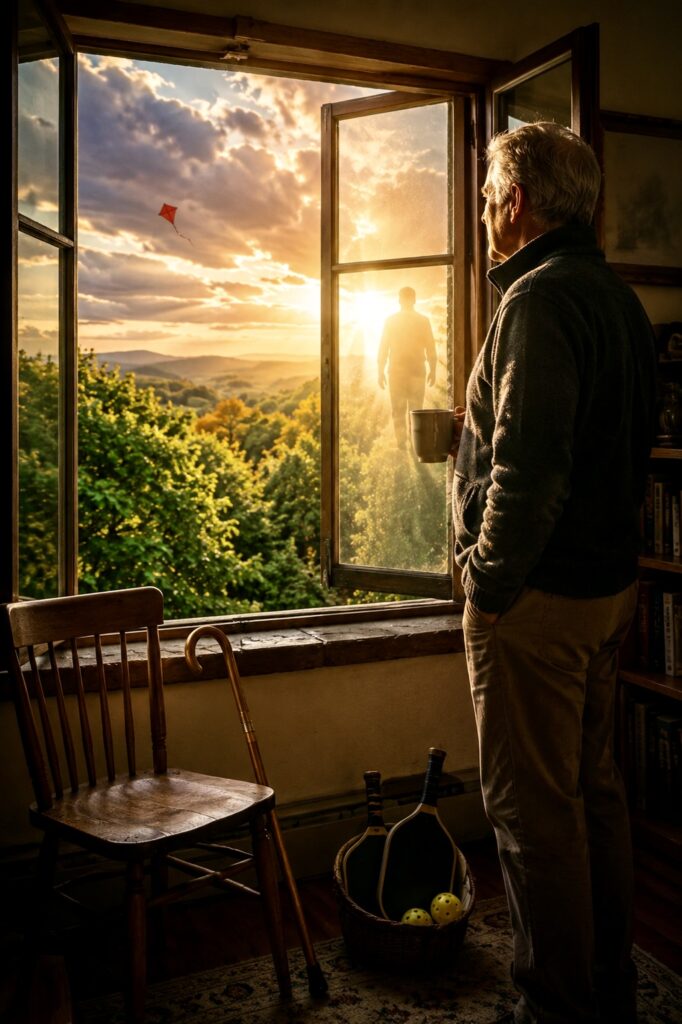
    Six weeks after hip replacement surgery, I’m back playing pickleball again.

    In sports comeback lore, this one may not rank alongside the 2019 Masters victory by Tiger Woods or the 2004 Boston Red Sox, but it feels pretty special to a few folks around here. Pickleball was the last domino to fall in the journey toward getting my life back. It feels good to be out there again, and I’m deeply grateful.

    Of course, the greatest comeback story in history is the resurrection of Jesus.

    Other comeback stories of biblical proportion would surely include Job, Joseph, and Peter.

    In the 42 chapters of the Book of Job, we witness the loss of family, wealth, and health. It is an excruciating narrative of pain and suffering that ultimately ends with restoration and grace. God returns what was lost and doubles what remained.

    In Book of Genesis, Joseph is betrayed by his brothers and sold into slavery. Proof that being the youngest in the family isn’t always easy. 😂 Through his God-given ability to interpret dreams, he rises to become the second most powerful man in Egypt.

    But his rise to power isn’t the best part.

    The real triumph comes in reconciliation. Joseph looks at the very brothers who harmed him and says, “You intended to harm me, but God intended it for good.” That is the sound of a wounded heart transformed by grace.

    Simon Peter’s fall may be the easiest to identify with. Fear drove him to deny knowing Jesus in order to save himself. Yet after breakfast on a beach with the resurrected Christ, Peter is restored. The man who once hid in fear becomes a bold leader of the early church.

    Do you have a comeback story?

    God is still in the comeback business.

    Some of us believe we cannot come back from something we’ve done, something done to us, or something we’re still struggling to escape. That’s a lie.

    Nothing is too broken, too far gone, or too hard for God.

    The Father is still welcoming home the Prodigal and killing the fatted calf.

    The Good Shepherd is still leaving the ninety-nine to search for the one.

    Mary’s Son is still turning water into wine.

    Run the Play:

    Ask God to give you a platform to share, or perhaps even co-author, your own comeback story.

    Finding Our Place in the Story

    Where in your life do you most need to believe that God is still writing a comeback instead of closing the book?

  • Nothing to Prove

    “Shalom I leave you, My shalom I give to you; but not as the world gives! Do not let your heart be troubled or afraid.” — John 14:27 TLV

    One of the most difficult lies I’ve had to overcome in life is the belief that I am not enough.

    This lie fuels life’s endless “if onlys.”

    If only I had more money.
    More stuff.
    More knowledge.
    More relationships.
    More trophies.
    More security.

    Then I would be enough. I would be full. Content.

    Unfortunately, the “mores” never fill the void.

    We’ve been watching The Chosen, a historical drama television series depicting the life and ministry of Jesus of Nazareth through the eyes of those who encountered Him. One of the words we often hear the characters say is shalom, and sometimes shalom-shalom.

    It’s not a modern word. In English, it is often translated as peace. But biblical peace is far more than the absence of conflict.

    Shalom means wholeness—things restored to the way they were meant to be.

    And shalom is humankind’s deepest desire. Thinkers across the centuries have noticed this same hunger.

    Pascal, a 17th-century mathematician and philosopher, described a “pre-existing hunger” or sense of lost happiness that humans try to fill with anything they can find:

    “What else does this craving and this helplessness proclaim but that there was once in man a true happiness, of which all that now remains is the empty print and trace? This he tries in vain to fill with everything around him… though none can help, since this infinite abyss can be filled only with an infinite and immutable object; in other words by God himself.”

    C.S. Lewis popularized a similar theme in Mere Christianity, arguing that if we find desires that nothing in this world can satisfy, it may be a sign that we were made for another world.

    Centuries before Pascal, St. Augustine wrote in his Confessions:

    “You have made us for yourself, O Lord, and our hearts are restless until they find their rest in you.”

    The prophet Isaiah foretold that the Messiah would be called the Prince of Peace and that there would be no end to His shalom (Isaiah 9:6 TLV).

    Jesus is Shalom Personified.

    The apostle Paul says in Ephesians that Jesus is our peace.

    Not just gives it.
    Is it.

    Much of modern life runs on performance identity, a constant striving after:

    Career
    Education
    Achievements
    Social media
    Reputation

    But the gospel gives us something entirely different.

    Received identity.

    In Christ we are children of God—welcomed, accepted, and beloved.

    Nothing to prove.
    A free gift of grace.

    In Christ, you already belong.

    That is shalom.

    The human condition, however, is such that shalom can be difficult to retain.

    Hurry fractures it.
    Comparison corrodes it.
    Control sabotages it.

    But gratitude restores it. (Philippians 4:6–8)

    Shalom may not be something we “hold onto” as much as something we repeatedly return to.

    Run the play. The only thing we ultimately need more of is shalom.

    More Jesus.


    Finding Our Place in the Story

    Where in your life do you most feel the pressure to prove that you are “enough”?

    Which of these tends to rob you of shalom most often: hurry, comparison, or control?

    What might it look like this week to stop striving for more and instead receive the peace Jesus already offers?

  • Nuns, Rulers, and Running the Rule

    “Whoever spares the rod hates their children, but the one who loves their children is careful to discipline them.”
    — Proverbs 13:24 (NIV)

    In my mind’s eye, I can still see Sister Sheila rhythmically smacking that twelve-inch ruler against her palm as she shuffled back and forth in front of her sixth graders. Funny how some memories still strike terror into hearts that are technically “young at heart.”

    She had a ruler.
    And she wasn’t afraid to use it.

    The word ruler comes from the Old French reule and the Latin regula, meaning a straight stick—a guide. It shares a root with regere, “to lead” or “to make straight,” which is also where we get words connected to royalty—those who “rule.”

    By the 6th century, regula came to describe something very different from Sister Sheila’s classroom enforcement tool. It became associated with spiritual communities like the Rule of Saint Benedict.

    But here’s the key: a Rule wasn’t a list of “Do this or you’re grounded.” It was a framework. A trellis. A structure designed to help a person—or a community—grow in a specific direction.

    Benedict understood something profound: if you put a bunch of humans together without a shared rhythm, chaos wins. So he created a pattern of prayer, work, study, and rest—a rhythm that aimed hearts toward God.

    Think vineyard.

    For a vine to “bear much fruit,” it needs a trellis. The trellis lifts it off the ground and guides it toward the light. Without it, the vine produces a fraction of what it’s capable of—and even that is vulnerable to disease and predators.

    A Rule of Life for humans does what a trellis does for grapes.

    Years ago, I developed what I called a personal “operating system”—a scorecard. Not everyone loved the word. It sounded a little… corporate. But it functioned much like Benedict’s Rule. It helped ensure that my daily activities aligned with my deepest values.

    Recently, I read Practicing the Way by John Mark Comer, and he gave language to what the Spirit has been teaching me for years:

    A Rule of Life is a schedule, set of practices, and relational rhythms that create space for us to be with Jesus, become like Him, and do as He did.

    That’s it.

    A Rule isn’t about earning anything. It’s about arranging your life around apprenticeship to Jesus.

    Without a rule, you live reactively—responding to texts, emails, headlines, and other people’s agendas.

    With a rule, you live proactively—with focus, direction, and passion.

    It’s how you leverage an ordinary Wednesday for eternal impact.

    Sister Sheila and the nuns at St. Mary’s almost certainly had both kinds of rulers—the wooden kind and the regula kind. Beneath the discipline was a deeper goal: formation. They were training us for lives of meaning and purpose.

    Discipline is never the destination.
    It’s the pathway.

    Rule of Life practices are disciplines based on the lifestyle of Jesus that create space for us to access the presence and power of the Spirit—and be transformed from the inside out.

    Which brings us home.

    “Run the play” is another way of saying: run the rule.

    Don’t drift.
    Don’t react.
    Design your life around becoming like Jesus.

    Finding Our Place in the Story


    Where am I currently living reactively instead of intentionally? What rhythms or practices might Jesus be inviting me to build into my daily life?


    If my current schedule reveals what I truly value, what does it say about who (or what) I am becoming? What small trellis could I put in place this week to guide my growth toward Christlikeness?


    How can our community encourage one another to “run the rule” — not through pressure or performance, but through shared rhythms that help us be with Jesus, become like Him, and do as He did?

  • Gremlins at the Gate

    “Catch for us the foxes, the little foxes that ruin the vineyards…” Song of Solomon 2:15

    Last Wednesday, a horde of mischievous, destructive gremlins showed up uninvited and went to work on the tech that supports my life.

    The first shot across the bow?
    My coffee maker refused to brew my morning lifeline.

    Then came a text from UPS about a delivery delay.
    Followed quickly by the realization that my Running The Play blog post email hadn’t been sent… and refused to be sent.

    “Well, that’s fantastic.”

    Just like those little foxes that can ruin a vineyard, it’s often the small things that can ruin a day—or even a week. They frustrate us, derail our momentum, and quietly chip away at our attitude.

    And if I’m being honest… they got to me.

    I felt a little like Sherlock Holmes declaring, “The game is afoot.” I’m usually pretty good at solving tech issues on my own. Around the house, I’ve even earned the nickname “tech support.”

    But this gremlin wasn’t going away without a fight.

    If you’re reading this as an email, then I have succeeded—at least for now—in taking ground from this invisible enemy. I can’t say exactly how or why it’s working again, but there’s something to be said for perseverance in the face of setbacks and resistance.

    In his letter to the Ephesians, the apostle Paul the Apostle reminds us that “our struggle is not against flesh and blood.” He wasn’t talking about broken coffee makers or stubborn email platforms… but in the moment, it sure felt like someone didn’t want this message to reach your inbox.

    Maybe the goal isn’t a gremlin-free life…

    Maybe it’s learning to persevere, stay steady, and take ground anyway.

    Run the play.
    Persevere until you break through.


    Finding Our Place in the Story

    What small “foxes” or everyday frustrations are currently threatening to steal your focus, your joy, or your momentum—and what would it look like to take ground anyway?

  • The Masters

    “I no longer call you servants, because a servant does not know his master’s business. Instead, I have called you friends.” — John 15:15

    A tradition unlike any other … ”

    March Madness has come and gone. The dogwoods and azaleas are beginning to bloom, and it can mean only one thing: the tax filing deadline has arrived.  

    Or, The Masters. 🙂

    For some, the word masters might bring to mind a gallery filled with the works of Leonardo da Vinci, Michelangelo, or Raphael. For others, it’s a pristine golf course and a Green Jacket.

    But in either case, the idea is the same:
    A master is someone who has reached the highest level of skill, excellence, and influence—someone who sets the standard.

    It’s rare air.

    Only a handful of golfers have ever achieved the career grand slam. The best in the world spend a lifetime chasing mastery… and most never quite get there.

    And yet—
    2,000 years ago, the greatest Master who ever lived redefined greatness entirely.

    Not from a stage.
    Not with a trophy.
    Not with a following.

    But on His knees… with a towel… washing feet.

    In that moment, Jesus showed us what true mastery looks like:
    To love.
    To serve.
    To elevate others.

    To descend into greatness.

    He didn’t just teach it—He modeled it. And then He did something even more stunning…

    He called them friends.

    That changes everything.

    Because it means the goal of our lives isn’t just what we accomplish—it’s why we do it.

    We don’t find meaning in our work.
    We bring meaning to our work.

    When we live and act with Jesus, every part of our lives—our choices, relationships, work, creativity, even our prayers—takes on eternal significance. These are not small, isolated acts. They are the raw materials of new creation.

    Nothing done in love is wasted.
    Not one swing. Not one step. Not one act of obedience.

    I love watching The Masters each year. It’s a beautiful thing to witness excellence under pressure. The precision. The discipline. The pursuit of perfection.

    But let’s be honest…

    Every trophy fades.
    Every champion is eventually forgotten.
    Even the Green Jacket gathers dust.

    But a life lived with and for the Master?

    That echoes into eternity.

    As Mother Teresa reminds us, it’s not about doing great things—it’s about doing all things with great love.

    A Green Jacket is just a jacket when it’s done for personal glory.

    But the smallest act—done with Jesus, for Jesus—
    That’s mastery.

    That’s legacy.

    That’s the life we’ve been invited into.

    Run the play.
    Do all things well—
    for the Master’s reputation, not ours.


    Finding Our Place in the Story

    1. Where am I tempted to chase recognition or “my Green Jacket,” instead of quietly pursuing faithfulness with Jesus?
    2. What is one ordinary area of my life that I can intentionally do with great love this week?
    3. How would my daily work change if I truly believed nothing done in love is wasted?
  • The Best Supper

    When the hour came, Jesus and his apostles reclined at the table. And he said to them, “I have eagerly desired to eat this Passover with you before I suffer. For I tell you, I will not eat it again until it finds fulfillment in the kingdom of God. – Luke 22

    This is a close rendering of what I saw

    Growing up, all the major events of our lives were centered around the supper table. Mom called it the altar of the home. It seemed to us she was always feeding a crowd, and even when she wasn’t, she made enough food to feed one. It’s amazing how the fellowship of sharing a meal anchors so many important memories.

    Not coincidentally, the supper table also figures prominently in the Gospel story and the promise of new creation.

    One night, after hip replacement surgery, when I was having trouble sleeping, I was praying about this blog post for Holy Week. I frequently invite God to speak to me in pictures in those sleepless hours, but He rarely does so. On this night, He did. As I prayed with eyes closed, for a few brief seconds, a picture of the table at The Last Supper pierced the darkness. The clarity startled me and moved me deeply.

    In that brief vision, the table and the elements were the prominent features. It was beautiful in its simplicity. An answered prayer… but now what? Since receiving the vision, I’ve felt a burden to steward its significance so that it could become a shared blessing.

    The first great supper in Israel’s story was Passover—the meal of rescue, remembrance, and redemption. But on the night He was betrayed, Jesus took that table and turned it like a key in a great lock. The old story was not discarded; it was fulfilled. What began in Exodus now found its center in Him.

    The Last Supper became the final meal of the old sacrificial age…
    and the opening note of God’s new creation.

    And now, whenever we come to His Table, we are not only looking back to what He has done. We are also leaning forward toward what is coming: the wedding supper of the Lamb, where sorrow will be swallowed up and all things will be made new.

    “Mom called it the altar of the home.”

    Passover looked back to Egypt.
    The Last Supper looked ahead to the cross.
    The Lord’s Supper now looks both ways—back to the Lamb who was slain and forward to the feast where all things are made new.

    As we move through the rest of Holy Week, we’ve been invited to focus on the table and its place in the passion story—past, present, and future. When you close your eyes and imagine the wedding supper of the Lamb, whose faces do you see around the table?

    Thursday our focus will be on the table.
    Friday we grieve because our Savior suffered, died, and was buried for our transgressions.
    Sunday we will feel the joy of our redemption at the empty tomb. He is risen, and so are we.

    Run the play. Get ready for The Best Supper—the wedding supper of the Lamb in the new creation.

    He is risen indeed!!

    Finding Our Place in the Story


    When you picture the wedding supper of the Lamb, do you see yourself at the table—and who is missing that God may be inviting you to help bring with you?

  • Life in the Slow Lane

    “Be still and know that I am God.” – Psalm 46:10

    How many times have you passed the little old blue-haired lady on the Interstate with two hands gripped to the steering wheel, going 40 in a 70?

    I now have a new appreciation for her, because that’s what life feels like for me after hip replacement surgery.

    Hipster, hip hip hurray, hippie, Hip-Hop, and other derivatives have been making their way to my ears from the mouths of good-natured friends and family since my surgery on March 9th. I know their ribbing is just a cover-up for jealousy as I parade around with my new bionic appendage like a proud owner of a new car.

    The only thing better would be a touch of that “new car smell.” I’ll mention it to the surgeon.

    So far, all I’m sure of is that surgery is a journey, not an event.

    In addition to doing the research before deciding to move forward, there were a half-dozen pre-op hoops to jump through weeks before surgery. The post-op PTs kept reminding me that it would take 6–8 weeks for a full recovery. When I tried to negotiate the timeline, I was told it would be 6–8 weeks… even if I were 17 rather than 70.

    PTs don’t play fair or nice.

    As I write this, I’m exactly two weeks into the recovery, and by all accounts, things are going very well. Everything takes longer to do, and my day-to-day activities are greatly diminished… temporarily. My steps are slow and deliberate.

    And if I’m honest, that’s not just physically frustrating—it’s spiritually revealing.

    I’ve spent most of my life moving fast, getting things done, measuring progress. Slowing down feels like losing ground… even when I know it isn’t.

    As I walk, I remember my brothers, veterans of this procedure, saying, “Whatever you do, don’t fall.” I’m slow, and my leg wears down quickly.

    No spills so far!

    I remembered what the Psalmist said, “Be still and know that I am God.”

    “Be still” doesn’t necessarily mean slow down. It means stop striving.

    Psalm 46 emphasizes God as our refuge and strength, especially in times of trouble. It reminds us that even in the middle of chaos, we do not need to fear. God is present. God is powerful. Our focus shifts from our circumstances to His character.

    Psalm 46

    The operation may be over, but the surgery journey is not.

    “Be still and know that I am God” doesn’t mean “do nothing.” It means we do our part and trust God with His.

    Post-surgery, it means doing the PT work and trusting God for the outcome.

    The Lord is inviting us to stop living as if we are in control and instead focus on the work He has given us to do.

    We are in the obedience business.
    God is in the outcome business.

    Life is hard. Whatever circumstances you are navigating, you can trust God’s character.

    He is good.
    He is for you.
    He has not left.
    He will not change.

    Run the play. Be still and trust God.

    Put in the work… and let go of the outcome—and the timing.


    🧭 Finding Our Place in the Story

    Where in your life are you being forced to slow down—and what might God be revealing to you in that space?

    What does “doing your part” look like right now, and where might you be trying to control outcomes that belong to God?

  • Busted Brackets and Chasing the Wind

    “Time and chance happen to them all.” (Ecclesiastes 9:11)

    Ecclesiastes repeatedly pokes at humanity’s obsession with control.

    “The wise don’t bet their lives on vapor.”

    Spring has descended upon us, and there are two things we can depend on: severe thunderstorms and “March Madness.” One of them we’ve gotten reasonably good at predicting. The other—not so much. Both, however, have a way of exposing our illusion of control.

    March Madness is one of those cultural moments when the whole country becomes focused on the drama of college basketball. Each year millions of people fill out tournament brackets believing they’ve cracked the code—stats, matchups, expert picks, analytics.

    Then a 14-seed beats a 3-seed and the whole thing explodes by lunchtime.

    Bracket pools are a perfect metaphor for something that looks harmless on the surface but quietly reveals deeper heart dynamics. We think we’re predicting reality, but more often we’re just pretending we can control chance.

    I had a front-row seat to this same impulse during my years as a financial advisor. Clients routinely asked us to predict future stock market returns. Entire departments at major investment firms are devoted to the “science” of forecasting market performance.

    But after forty years in the industry, I can tell you something with confidence: when experts reach a strong consensus about what the market will do next, that consensus often becomes the least likely outcome.

    Like a busted bracket, the predictions fall apart.

    The Teacher in Ecclesiastes would have a word for this: chasing the wind.

    In recent years the gambling industry has discovered how profitable this human tendency can be. The expansion of sports betting in our country is breathtaking—and often destructive.

    A $10 office bracket may feel harmless. But modern sports-betting apps are carefully designed around dopamine loops:

    Small bets → near misses → chasing losses → bigger bets.

    This is not wisdom. It is vapor. And it is quietly destroying many lives and families.

    Whether we are watching sports or watching our investment portfolios, we must guard our hearts against the temptation to believe that enough knowledge, enough data, or enough confidence can allow us to control the future.

    We can’t.

    But the pursuit of control can certainly begin to control us.

    Interestingly, the Teacher of Ecclesiastes doesn’t leave us in despair. He offers a better way:

    “There is nothing better… than to eat and drink and find satisfaction in their toil.” (Ecclesiastes 2:24)

    Run-the-Play translation for March Madness:

    Enjoy the game.
    Laugh at busted brackets.
    Cheer for the Cinderella team.

    But don’t look to chance for meaning or security.

    We can build our lives on a solid foundation—the Rock of Ages—or we can spend our days grasping at the wind.

    March Madness reminds us how fragile our predictions really are. One buzzer-beater and the illusion of control disappears like vapor.

    Finding Our Place in the Story

    If your current “life bracket” were suddenly busted—plans changed, predictions failed, outcomes uncertain—what would remain steady in your life, and what might that reveal about where your true security rests?