Running The Play Logo

Category: RTP

  • Life is Difficult

    I applied my mind to study and to explore by wisdom all that is done under the heavens. What a heavy burden God has laid on mankind!
    — Ecclesiastes 1:13

    Many years ago, when I read M. Scott Peck’s The Road Less Traveled, I was hooked by the very first sentence:

    “Life is difficult.”

    Wait…what? 😅

    It was strangely refreshing. Finally—honesty. Until then I assumed other people had discovered some secret path that made life easier than what I was experiencing. That single sentence popped the bubble.

    Life is hard…for all of us.
    But hard can also mean good.

    I’ve heard countless couples say, “Marriage is hard work.” Sharon and I—forty-two years strong—prefer to say, “Marriage is good work.” Partnering to build a life together is a privilege. Every day feels like a gift.

    Our culture keeps engineering a friction-free existence:

    • Faster lanes
    • Shorter lines
    • Easier routes
    • Less inconvenience

    Meanwhile, Jesus keeps guiding people onto slower roads—roads where formation actually happens.

    John Mark Comer, in Practicing the Way, notes:

    “Spiritual formation is the slowest of all human movements…
    The human soul doesn’t grow at digital speed.”

    Maybe the “heavy burden” Ecclesiastes mentions isn’t punishment but reality. We were never meant to find ultimate fulfillment in temporary things. Something in us aches for more because we were made for more.

    This is not our forever home.

    Each of us is on a long journey toward wholeness. Deep inside, we long for shalom—peace, restoration, and life with God as it was meant to be.

    “He has made everything beautiful in its time. He has also set eternity in the human heart…”
    — Ecclesiastes 3:11

    The road to wholeness isn’t fast, easy, or crowded.
    But it is good.
    Run the play—run down the road less traveled.

    Finding Our Place in the Story

    What if the difficult parts of your life are not interruptions to your spiritual growth, but the very place where God is forming you most deeply?

  • A Big Bold Beautiful Journey

    “The sleep of a laborer is sweet, whether they eat little or much, but as for the rich, their abundance permits them no sleep.”
    Ecclesiastes 5:12

    While flying home from Germany recently, I watched a few movies. One of the more unusual ones was A Big Bold Beautiful Journey. I found it while scrolling through the available titles and was intrigued. It had good actors, an interesting storyline, and I had eight hours to spare.

    So I tuned in.

    It’s a fantasy about two strangers who meet at a wedding and are given the chance to revisit important moments from their past, moments that helped shape who they became and where their lives were headed. Like you and me, they were flawed people carrying regrets, wounds, and longings they didn’t always know what to do with.

    I’ve been spending a lot of time in Ecclesiastes these days, and one of the film’s messages sounded a lot like the Teacher’s warning about the burden of wealth: the elusive and never-ending pursuit of more.

    In this case, though, the movie wasn’t really about money or possessions. It was about the pursuit of happiness.

    The two main characters, David and Sarah, were doing pretty well by most ordinary measures. They were functioning, achieving, surviving, even “crushing it” in ways the world tends to applaud.

    But they weren’t at peace. They weren’t happy. At least, not for long.

    Each time they reached for what they thought would finally satisfy them, it slipped through their fingers. The moment passed. The feeling faded. The hunger returned. Whatever they captured couldn’t hold the weight of their deepest longing.

    That’s the trouble with chasing happiness as the goal. Happiness is a wonderful gift, but it makes a terrible god.

    The magic of the movie allowed David and Sarah to become both actors and observers of their own lives. They were able to step back and see the stories they had been living in, including the moments when they gave in to fear, disappointment, pain, and desire.

    In one of the movie’s best scenes, Sarah looks back on her 12-year-old self and hears her mother say:

    “Choose to be content first and enjoy the moment of happiness that comes from that.”

    That line stayed with me.

    Movies have a way of holding up a mirror to our own lives. A Big Bold Beautiful Journey succeeds in the same way It’s a Wonderful Life does. Both films use make-believe to sharpen something deeply true:

    Contentment is not the consolation prize.

    Contentment is the doorway.

    The apostle Paul plays this same contentment chord in his letter to the Philippians, but he adds something the movie could only hint at:

    “I have learned the secret of being content in any and every situation, whether well fed or hungry, whether living in plenty or in want.”

    The secret?

    “I can do all things through Christ who gives me strength.”

    Paul’s contentment wasn’t rooted in personality, circumstances, comfort, income, health, applause, or control. It wasn’t rooted in getting the life he always wanted.

    It was rooted in Christ.

    That’s why Jesus’ words in John 6 are so stunning:

    “I am the bread of life. Whoever comes to me will never go hungry, and whoever believes in me will never be thirsty.”

    Jesus was not offering a religious hobby, a little spiritual encouragement, or a motivational quote for the refrigerator.

    He was offering Himself.

    He was proclaiming that every longing of the human spirit eventually finds its true home in Him. Not because our circumstances always change. Not because life becomes easy. Not because every wound disappears overnight.

    But because He is enough. Everything else eventually asks for more.

    Jesus gives Himself.

    In this big, bold, beautiful journey we are all taking, the only all-consuming pursuit that satisfies without fail is Jesus: to be with Him, to become like Him, and to do as He did.

    Run the play: Choose contentment

    Align your life with the One who created you, knows you, and loves you.

    Finding Our Place in the Story 💡

    Where do you feel the tension between pursuing happiness and learning contentment?

  • Render Unto Caesar, But Don’t Move In

    For where your treasure is, there your heart will be also.
    – Matthew 6:21

    In just three more days, America turns 250!

    A few weeks ago, we had the privilege of spending time in Croatia, exploring the places where my maternal grandparents were born, and the church where they were married. They emigrated to America in the early 1900s. As we walked in the places where they had walked before us, we tried to imagine the problems, challenges, and risks they faced that led them to leave their home and make a new life in America.

    My grandparents’ faith and courage continue to inspire me. They came to the USA for an opportunity, a chance for a better life, and they found one here. The decisions they made more than 100 years ago made it possible for my brothers and me to be born in America. World War II created the events that would eventually enable our parents to meet, and then fall in love.

    Somehow, profound hardship and tragedy became part of the story that allowed my brothers and me, and so many others, to live in this country during an extraordinary time in history. I am still amazed by it, and grateful beyond words.

    I love this country, but for followers of Jesus, America is not our home. I guess you could say we have dual citizenship. I have a temporary USA Passport, but my permanent citizenship is of the Kingdom of God.

    At this time in America’s history, followers of Jesus:

    • Can be grateful for America without confusing America with the Kingdom of God.
    • Can honor freedom without worshiping independence.
    • Can celebrate citizenship while remembering that our deepest citizenship is in heaven.

    Some 2,500 years ago, the prophet Jeremiah wrote this to the Jewish exiles in Babylon:

    “Seek the peace and prosperity of the city to which I have carried you into exile. Pray to the LORD for it, because if it prospers, you too will prosper.”

    God, through Jeremiah, wanted the people to influence and disciple the culture. They were His representatives, His chosen people, even in exile.

    They were chosen to represent God to the world.

    In the same way, we love our country best when we love it as apprentices of Jesus. Jesus told His disciples that where your treasure is, there your heart will be also. We are uniquely capable of living above the daily squabbles and power struggles of the two prevailing political parties in America because our treasure and future is secure.

    We are not free because we have no concerns. We are free because our deepest hope is not held hostage by the fight.

    Our King is on the throne, and the Kingdom of God goes where we go. I wonder if my grandparents shared that perspective when they left Croatia. Did they know where their treasure resided?

    Apprentices of Jesus know where the deepest healing begins. Political and legal solutions matter, and we should seek justice and wisdom in public life. But they cannot heal the deepest sickness beneath our brokenness. Only Jesus can do that.

    This may not be our permanent home, but it is still a place we have been called to love. So we pray for its peace. We seek its good. We refuse to make an idol of it, and we refuse to give up on it.

    Run the play. Let’s celebrate a country we love, and love one another well this Fourth of July.

    Finding Our Place in the Story

    What would it look like for you to celebrate America with gratitude, pray for her with humility, and live as a citizen of heaven?

  • The East Wind Still Blows

    No one remembers the former generations, and even those yet to come will not be remembered by those who follow them.Ecclesiastes 1:11

    “Wheaties, Wheaties, Wheaties, that’s all we get, bloody Wheaties.”

    I don’t remember what I had for breakfast yesterday, but I remember Red Fox complaining about Wheaties 52 years ago. Tom, his real name, was from London, had flaming red hair, and a temper to match.

    This is a fun memory from summer camp in 1974, my first time as a camp counselor. I had no prior experience or qualifications, but I was eager to prove myself and am grateful for the experience and the memories.

    Recently, a young friend asked for a reference to help acquire his first summer camp counselor position, and ever since, he has stoked my own camp memories like a well-placed poke to a campfire.

    What is it about first times that makes them so special? We remember first camp, first car, first apartment, first child, first real taste of responsibility. We are not just remembering the event. We are remembering the moment we felt the world get bigger.

    I have no idea why those memories stuck. I can forget why I walked into the kitchen, but I can still hear Red Fox protesting the cereal situation like he had been personally betrayed by the Kellogg’s Corporation.

    Memory is funny that way.

    It does not preserve life evenly. It saves fragments. A smell. A song. A nickname. A cabin, Seminole. A campfire. A first taste of responsibility. A moment when we were young, and the world still felt wide enough to surprise us.

    We remember those moments because something in us was waking up.

    In 1974, my camp name was East Wind. At the time, it was part of the camp tradition and ceremony. I’m sure I liked the drama of it all. Who wouldn’t want a name that sounded like it came with a canoe, a campfire, and at least one horsefly the size of Manhattan?I even made a wooden name tag in arts and crafts with East Wind burned into it, strung with twine so I could wear it around my neck like official camp royalty.

    But all these years later, I wonder if there was something more going on.

    The East Wind was connected to the rising sun. A new day. A beginning. A first light.

    And maybe that is what our best memories do. They do not make us permanent, but they awaken us to the reality that we were made for something eternal.

    Ecclesiastes tells us we will not be remembered forever. Scripture tells us to remember anyway.

    That is not a contradiction. That is an invitation.

    We do not remember because memories can hold us forever. We remember because they help us recognize the One who can.

    The camp songs fade. The cabins change. The cereal improves. Hopefully.

    But the East Wind of God still blows.

    Sometimes it comes through Scripture. Sometimes through worship. Sometimes through a conversation. Sometimes through a memory we did not know we still needed.

    And sometimes, by the grace of God, it comes through a red-haired counselor from London complaining about bloody Wheaties.

    Run the play: Replay the memories, and listen for the voice of the One who is calling you home.

    Finding Our Place in the Story

    What memory from your life still feels strangely alive, and how might God be using it to remind you that you were made for more than what fades?

  • When the World Comes to Play

    “The nations will walk by its light, and the kings of the earth will bring their splendor into it. On no day will its gates ever be shut, for there will be no night there. The glory and honor of the nations will be brought into it.” Revelation 21

    The World Cup, the World Series, and the World That Jesus Loves

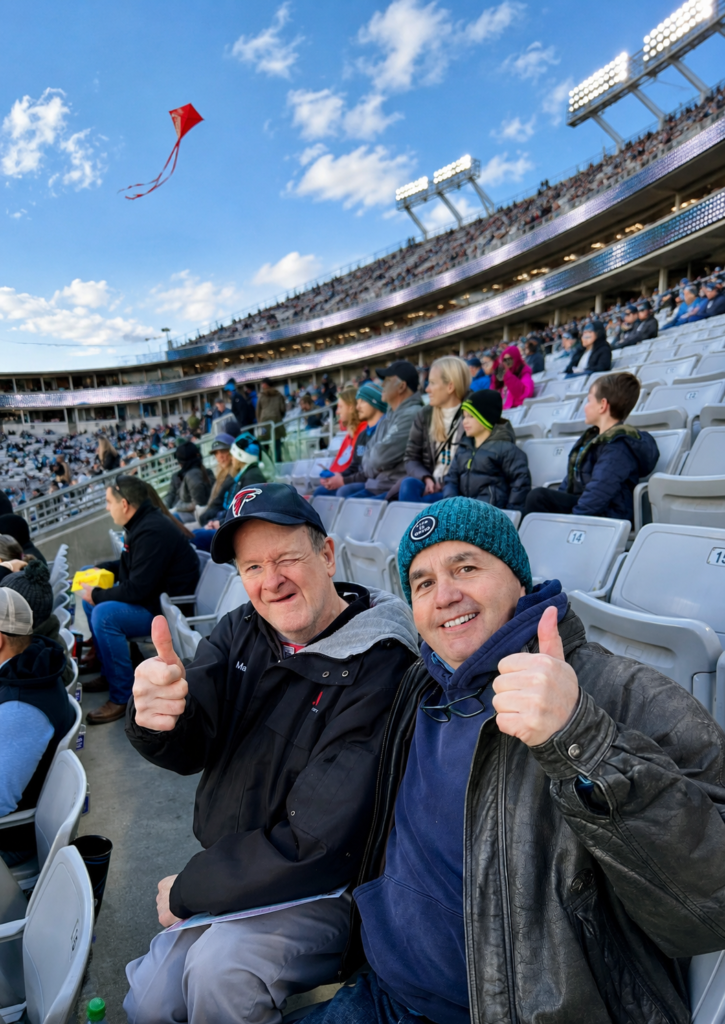
    The FIFA World Cup is now a 48-team tournament, running across Canada, Mexico, and the U.S., with 104 matches on the schedule. The College World Series has also started in Omaha, with eight teams competing for the national championship. Add the recent NBA and Stanley Cup Finals, and the air is supercharged with enough hype to propel a testosterone wind farm. 😂

    And boy howdy, it’s been fun to watch.

    I’m grateful for HD and 60-inch screens, because it wasn’t that long ago that we would have been straining to see the action on something much smaller and far less desirable. Or not at all. These technological advances are giving us front-row seats to witness some of the best competitive events the world has to offer.

    It’s also been enlightening to watch YouTube videos capturing the world’s fascination with all things American. Europeans fawning over Waffle House at 1:00 a.m. South Africans marveling at how safe it is here. Scottish bagpipers making their way to Boston’s Fenway Park. The Big Gulp and Buc-ee’s are having a moment too.

    It’s helping me see American culture in a new light. And it’s funny to boot.

    All of this got me thinking about how much God loves not only America, but the whole world.

    And isn’t it interesting how often people choose sporting events as a platform to remind us of that fact? It’s common to see someone holding up a “John 3:16” sign, strategically placed where the camera captures both the action and the message.

    “For God so loved the world…”

    He doesn’t love us or the world because we’re perfect, or even worthy. He loves us because that is His nature. God, in Jesus Christ, is on a rescue and redemption mission.

    He did not send His Son into the world to condemn the world, but to save the world through Him.

    When the world gathers as it is now through sports, I think it gives us a small foreshadowing of the future. In the book of Revelation, we read about a final gathering of people from every tribe, tongue, people, and nation.

    The world’s games divide us into flags, jerseys, colors, chants, brackets, and allegiances. And that can be a beautiful thing. But Jesus is doing something deeper than crowning a temporary champion.

    The world celebrates winners and gathers around trophies.

    Jesus is uniting the nations in a new heaven and a new earth, where He is gathering His people around a table and offering them a feast.

    And He is not merely the host.

    He is the feast.

    He is offering Himself.

    And He is a gentleman. The invitation from Jesus has not changed in 2,000 years. It is still, “Come, follow Me.”

    Run the play. Say yes to the invitation. Enter the epic procession. Take your seat around the table.

    Finding Our Place in the Story

    When you think about “the world,” do you mostly see headlines, opponents, strangers, threats, or people deeply loved by God?

    Where might Jesus be inviting you to love beyond your normal team, tribe, comfort zone, or circle of concern?

    What would it look like this week to say “yes” to Jesus’ invitation and help someone else find their seat at His table?

  • One Thing

    “But do not forget this one thing, dear friends: With the Lord a day is like a thousand years, and a thousand years are like a day.” — 2 Peter 3:8 (NIV)

    Billy Crystal is one of my favorite comedians. His filmography is wide and varied, but one scene stands above the rest. In City Slickers, three middle-aged friends head out on a cattle drive searching for meaning. The trail boss, Curly Washburn (played by Jack Palance), holds up one finger and tells Mitch Robbins (Billy Crystal) the secret to life:

    “One thing.”

    Just one thing.

    In his second letter, the apostle Peter has his own “Curly” moment.
    “Do not forget this one thing…”

    And what is it?

    God’s time is not our time. What feels like delay is actually mercy.

    The Lord is not slow. He is patient — purposefully patient — not wanting anyone to perish, but everyone to come to repentance.

    And repentance is more than regret. More than behavior modification. It is a Spirit-empowered reorientation of mind and heart — turning from deception and aligning ourselves with God’s revealed reality: His Kingdom. His new creation.

    We may not be City Slickers, but we share their longing. We want our lives to count. That quiet ache lives in every soul.

    So how do we make our lives count?

    Peter says it begins with turning from deception.
    What am I believing that isn’t true?

    Then comes alignment — day-by-day apprenticeship under Jesus. Or, as I like to say, running the play.

    Running the play is shaping a schedule, a set of practices, and relational rhythms that create space to be with Jesus, become like Him, and do what He would do if He were living my life.

    Here’s Peter’s one thing for us: God is not stalling. He is saving.

    So the real question isn’t, “Why is He waiting?”

    It’s, “Am I aligning?”

    We are all aligning with something. But there is only one alignment that makes our lives count in this world and the next:

    Follow the Invisible Jesus.
    One Way — the Way.

    Run that play.

    🧭 Finding Our Place in the Story

    What beliefs about time, delay, or “God not acting fast enough” might be subtly shaping my attitude toward Him right now?

    Where in my daily schedule do I see intentional alignment with Jesus — and where am I drifting without noticing?

    How can my church community more intentionally help one another align with the patient purposes of God rather than the hurried pace of our culture?

  • The Stories That Keep Them Near

    “There is a time for everything, and a season for every activity under the heavens… He has made everything beautiful in its time. He has also set eternity in the human heart.” – Ecclesiastes 3:1,11

    Exactly twelve years ago today, June 3, 2014, we got the call that my dad had passed away. It wasn’t unexpected. He had been declining for some time. Even now, I can remember where we were, what we were doing, and how I felt.

    What is it about birthdays, anniversaries, and death-days that makes them so important to us?

    Part of it is culture and tradition. These are rhythms handed down to us. But it feels deeper than that.

    The teacher from Ecclesiastes spent twelve chapters and more than 5,000 words wrestling with this mystery. I’ll attempt the short version.

    Whether we acknowledge it or not, our Creator has placed both time and eternity in our hearts. We are eternal spiritual beings living within a temporary human experience. The seasons and rhythms of life are not accidental. They are part of what it means to be human.

    “There is a time for everything,
    and a season for every activity under the heavens:
    a time to be born and a time to die.” Ecclesiastes 3:1–2

    Each death anniversary becomes an invitation to remember.

    At Dad’s burial service, we asked a close family friend, a man who had experienced both the loss of a child and the death of his spouse, to share a few words. One thought still reverberates in my heart:

    “Life, even when simple, is sometimes hard to understand. We live and love as hard as we can, all the while preparing for a parting of our ways.

    But we honor those we love most by keeping them alive through conversation, telling stories even when they hurt in this first while.”

    June is the month we remember not only my dad’s passing, but also my mom and father-in-law. Every June 3, 9, and 14, Sharon and I make it a point to honor our parents and retell stories.

    Stories are memory’s campfire. 🔥 We gather around them, warm our hands, laugh at details we almost forgot, and keep the people we love close.

    It also reminds us of something deeper: hope.

    For followers of Jesus, Christ lives in us, and those who died in Christ are with Him. So how far away could our departed loved ones truly be?

    Jesus confronted the Sadducees’ misunderstanding about death and eternity with these words:

    “Have you not read what God said to you: ‘I am the God of Abraham, the God of Isaac, and the God of Jacob’? He is not the God of the dead but of the living.” – Matthew 22:31–32

    Today, we’ll remember Dad through the retelling of favorite “Grambo” stories. We’ll laugh. We’ll miss him. And we’ll say a prayer for all of us still waiting to join them.

    A prayer that imagines a grand reunion. A place at the table. A kingdom where every goodbye finally runs out of breath.

    Run the Play: Embrace the people and seasons that shaped your story.

    Finding Our Place in the Story

    What memories, anniversaries, or seasons in your life invite you not only to look backward with gratitude, but forward with hope?

  • Narrative Fatigue

    “He was oppressed and afflicted, yet he did not open his mouth… like a lamb that is led to the slaughter.” — Isaiah 53:7

    That’s not how our world works.

    We live in a culture obsessed with controlling the narrative. The 24/7 noise of news, social media, podcasts, and entertainment all orbit around one idea: make sure your voice is heard. Protect your image. Tell your story first.

    Even in sports, what was once about the love of the game is now often wrapped in self-promotion and the pursuit of the almighty dollar. Improvements in officiating and technology are increasingly driven by gambling and betting algorithms rather than a desire to simply be good at what we do—a destructive narrative.

    Everywhere you turn, it feels like people are shouting, “Look at me.”

    We are obsessed with controlling the narrative.
    Image is curated. Stories are spun. Outcomes are engineered.
    Everyone’s trying to be the author of their own story.

    “Do not be quick with your mouth… God is in heaven and you are on earth, so let your words be few.” — Ecclesiastes 5:2

    Talk is cheap—and it’s getting cheaper. If you want to devalue something, flood the market with it. From where I sit, the inventory of words is at an all-time high, with no end in sight.

    We are drowning in words…
    opinions, takes, narratives, spin.

    Is anyone really listening?

    The Teacher from Ecclesiastes would call it what it is: wearisome.

    And then… there’s Jesus.

    The silent Lamb of God.

    He had every right to defend Himself.
    Every right to correct the record.
    Every right to silence His accusers with truth and power.

    But He didn’t.

    Not because He was weak—but because He was meek.

    Blessed are the meek, for they shall inherit the earth.” — Matthew 5:5

    Meekness isn’t weakness. It’s strength under control. It’s the quiet confidence that comes from knowing who you are and whose you are. It’s the ability to entrust your reputation, your future, and even your suffering to God.

    Jesus didn’t need to control the narrative—because He trusted the Author.

    And as His apprentices, we’re invited into that same way of being.

    To resist the urge to prove ourselves.
    To loosen our grip on recognition and control.
    To walk in humility and gentleness, even when misunderstood.

    This is radical. It’s countercultural. And it’s the way of the Kingdom.

    Because in the Kingdom of God, it’s not the loud who inherit the earth…

    It’s the meek.

    Run the play. Trust the Author of the one true narrative.


    Finding Our Place in the Story

    When you feel the urge to defend, explain, or control how your story is perceived, what would it look like in that exact moment to trust the Author instead?

  • Spotter! 🎳🍕

    “It gave me great joy when some believers came and testified about your faithfulness to the truth, telling how you continue to walk in it.” — 3 John 1:3

    Back in my late teens, I worked at a bowling alley. On Friday and Saturday nights, we had “Moonlight Bowling.”

    At midnight, things got interesting.

    We’d dim the lights and slip one bright red pin into the rack. If that pin landed in the head position—and the bowler threw a strike—they won a free pizza.

    Simple. Rare. Electric.

    My job? I was the spotter.

    When that colored pin showed up front and center, the bowler would yell, “SPOTTER!” as if their life depended on it. And I’d lock in—eyes on the lane—giving them the thumbs up and watching to see if they could deliver.

    You could feel the whole place lean in. Pins rattling. Neon glowing. That unmistakable bowling alley “aroma” hanging in the air. 😂 Most frames were just… normal.

    But every now and then? Something special.

    Fast forward a few years (okay… a few decades 😄), and I found myself reading Third Epistle of John 3 John.

    John is writing to a man named Gaius, and he’s basically doing the same thing we used to do at the bowling alley.

    He’s calling it out: “That’s it. That’s the life.”

    Gaius was opening his home. Supporting traveling teachers. Living generously and faithfully behind the scenes.

    Nothing flashy. But when you see it—you know.

    It’s a strike.

    What if we became that kind of community? The kind that notices the “colored pin” moments in each other’s lives:

    • quiet faithfulness
    • open homes
    • generous hearts
    • steady obedience

    And instead of letting it pass, we call it out:

    “SPOTTER!”

    Not to draw attention to people—but to celebrate what Jesus is doing as we apprentice under Him. Because most of life looks like a regular frame.

    Until it doesn’t. And maybe that’s the point.

    Most of the Kingdom is built in ordinary moments that don’t seem dramatic at the time. A meal shared. A prayer offered. A door opened. A quiet act of obedience that almost no one notices.

    But heaven notices.

    Because Jesus’ resurrection is the down payment of new creation, we can live with resilient hope—even in the face of suffering or loss—knowing that nothing done in love is wasted. It will somehow be woven into God’s final renewal.

    Every frame of our lives has eternal significance.

    Run the Play: Like a Moonlight Bowling spotter, let’s look for what God is doing in our midst—and give one another a thumbs up. Soli Deo Gloria.

    Finding Our Place in the Story

    Who in your life might need someone to notice, name, and encourage their quiet faithfulness right now?

  • “Your Mother Was Not a Failure” 😀

    What has been will be again, what has been done will be done again; there is nothing new under the sun. – Ecclesiastes 1:9

    Maybe it’s because we just celebrated Mother’s Day, but we often find ourselves quoting one of Mom’s favorite sayings, which had two variations: “Your mother was a failure,” and/or “Your mother was not a failure.” Mom was good at using humor to make a point or share an important lesson. Good manners were an important legacy she wanted for her children, and many times she told us “our mother” was or was not a failure. 🤣

    Her humorous way of delivering lessons on manners never missed its mark.

    “It’s always the mother’s fault.” – Sophie Mae Jette

    William Wilberforce is one of my heroes. Most people remember William Wilberforce as the man who fought to end the slave trade in England. Fewer remember that he also called for a “reformation of manners,” believing everyday acts of selfishness, disrespect, and disregard slowly erode the soul of a culture.

    As a culture, are we slowly losing the art of considering other people? Are we in need of a Wilberforce movement?

    Every civilization runs on millions of tiny acts of invisible consideration:

    • showing up when you said you would
    • answering texts and emails promptly … or at all
    • RSVPing before the final hour
    • putting the shopping cart away 😇
    • not treating every commitment like a tentative weather forecast

    Wilberforce believed the slave trade persisted partly because society had normalized coarseness, selfishness, and moral numbness. In his mind, manners were not superficial. They were evidence of whether people still saw one another as image-bearers of God.

    Being inconsiderate of others is more than just bad manners. It’s an outward sign of an inner condition. It reveals how we actually see one another. It may not seem like a big deal, but every culture slides toward devaluing humanity one small act of disregard at a time.

    Jesus taught, “The eyes are like a lamp for the body. If your eyes are sound, your whole body will be full of light.” The eyes Jesus was talking about were the condition of our hearts. Our behavior is shaped by what we perceive and believe. What Jesus, Wilberforce, and my mom understood is that we don’t need more laws to change behavior; we need a change of heart.

    A friend recently reminded me, “The New Testament calls the church to faithful presence, not panic and not passivity. We engage the world while remembering the Kingdom of God does not arrive on Air Force One or through campaign slogans.” The Kingdom of God arrives with us.

    There are no ultimate political or legal solutions to our problems because beneath every expression of brokenness lies a deeper spiritual disease that only Jesus can cure.

    Political leaders, governments, armies, and mothers may restrain evil for a season, but they cannot heal the human heart.

    There is nothing new under the sun. We are a culture desperately in need of a new reformation of manners.

    And no, not everything is the mother’s fault.

    Although Mom would probably disagree. 😂

    Run the play. Always be considerate of others.

    Finding Our Place in the Story

    What “small” act of consideration might actually be a much bigger expression of God’s Kingdom than I realize?