
“Time and chance happen to them all.” (Ecclesiastes 9:11)
Ecclesiastes repeatedly pokes at humanity’s obsession with control.
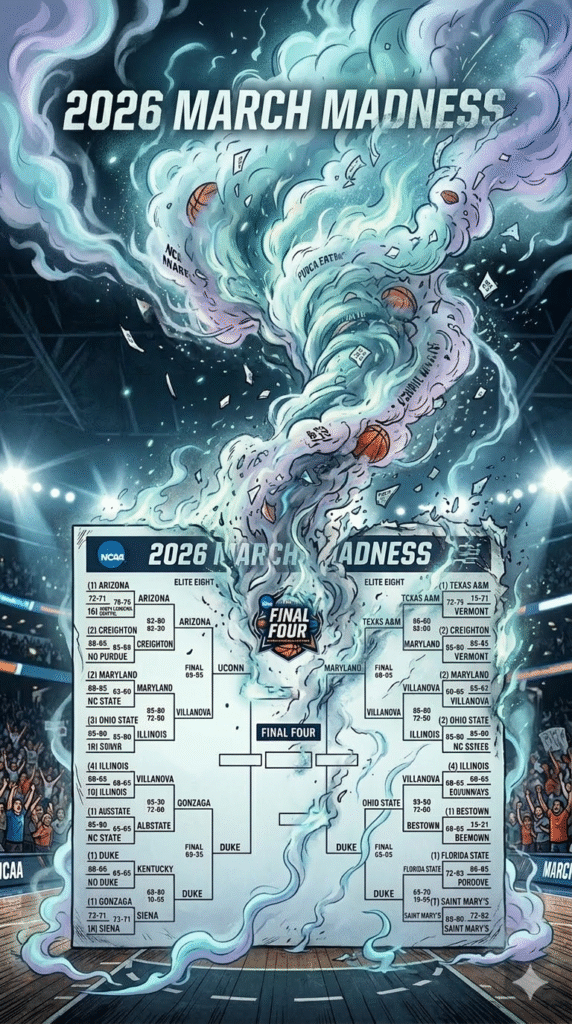
Spring has descended upon us, and there are two things we can depend on: severe thunderstorms and “March Madness.” One of them we’ve gotten reasonably good at predicting. The other—not so much. Both, however, have a way of exposing our illusion of control.
March Madness is one of those cultural moments when the whole country becomes focused on the drama of college basketball. Each year millions of people fill out tournament brackets believing they’ve cracked the code—stats, matchups, expert picks, analytics.
Then a 14-seed beats a 3-seed and the whole thing explodes by lunchtime.
Bracket pools are a perfect metaphor for something that looks harmless on the surface but quietly reveals deeper heart dynamics. We think we’re predicting reality, but more often we’re just pretending we can control chance.
I had a front-row seat to this same impulse during my years as a financial advisor. Clients routinely asked us to predict future stock market returns. Entire departments at major investment firms are devoted to the “science” of forecasting market performance.
But after forty years in the industry, I can tell you something with confidence: when experts reach a strong consensus about what the market will do next, that consensus often becomes the least likely outcome.
Like a busted bracket, the predictions fall apart.
The Teacher in Ecclesiastes would have a word for this: chasing the wind.
In recent years the gambling industry has discovered how profitable this human tendency can be. The expansion of sports betting in our country is breathtaking—and often destructive.
A $10 office bracket may feel harmless. But modern sports-betting apps are carefully designed around dopamine loops:
Small bets → near misses → chasing losses → bigger bets.
This is not wisdom. It is vapor. And it is quietly destroying many lives and families.
Whether we are watching sports or watching our investment portfolios, we must guard our hearts against the temptation to believe that enough knowledge, enough data, or enough confidence can allow us to control the future.
We can’t.
But the pursuit of control can certainly begin to control us.
Interestingly, the Teacher of Ecclesiastes doesn’t leave us in despair. He offers a better way:
“There is nothing better… than to eat and drink and find satisfaction in their toil.” (Ecclesiastes 2:24)
Run-the-Play translation for March Madness:
Enjoy the game.
Laugh at busted brackets.
Cheer for the Cinderella team.
But don’t look to chance for meaning or security.
We can build our lives on a solid foundation—the Rock of Ages—or we can spend our days grasping at the wind.
March Madness reminds us how fragile our predictions really are. One buzzer-beater and the illusion of control disappears like vapor.
Finding Our Place in the Story
If your current “life bracket” were suddenly busted—plans changed, predictions failed, outcomes uncertain—what would remain steady in your life, and what might that reveal about where your true security rests?

Leave a Reply to Terrell Stauffer Cancel reply