
“But you are a chosen people, a royal priesthood, a holy nation, God’s special possession, that you may declare the praises of him who called you out of darkness into his wonderful light.”
— 1 Peter 2:9 (NIV)
The church doesn’t have a mission; God’s mission has a church.
I grew up in a small blue-collar town where nearly everyone went to Mass. I’ve been going to church since before I was born—and for most of the last twenty-five years I’ve served in various Protestant leadership roles. That’s a lot of church.
When we lived in Milwaukee, I noticed how neighborhood bars dotted nearly every block. When we later moved South, it was churches instead—sometimes two or three on the same street. It’s no wonder people equate church with buildings, brands, or institutions.
But that’s not what Jesus had in mind when he said, “You are Peter, and on this rock I will build my church.”
In the Greek of the New Testament, the word translated church is ekklesia, literally “a calling out” or “the called-out ones.” In ancient Athens, the ekklesia was the civic assembly of citizens called out from private life to govern the city.
When Jesus said, “I will build my ekklesia,” He was describing a movement—a people summoned to establish His kingdom on earth. He was announcing the beginning of the tikkun olam, the repairing of creation, inaugurated by His resurrection as the down payment on a new heaven and a new earth.
He wasn’t talking about an earthly temple, but about living stones being built into a spiritual house—a holy priesthood—with Himself as the Cornerstone. (1 Peter 2)
Jesus’ use of ekklesia connected His followers to Israel’s story: a people called out of the darkness of slavery into the light of covenant relationship. That Old Covenant failed through human weakness, but now, under the New Covenant, His called-out ones are:
Not a building.
Not a brand.
But a people summoned for purpose—the visible expression of heaven’s rule on earth.
Mobile. Relational. Kingdom-minded. Living stones.
Somewhere along the way, we built buildings around the movement. We began to equate church with:
- Sunday services instead of seven-day sentness,
- Attendance instead of apprenticeship,
- Institution instead of incarnation.
Local churches are vital—they’re embassies of the Kingdom. But when we shrink ekklesia to a single address, we forget it’s more like a network of ambassadors than a club of attendees.
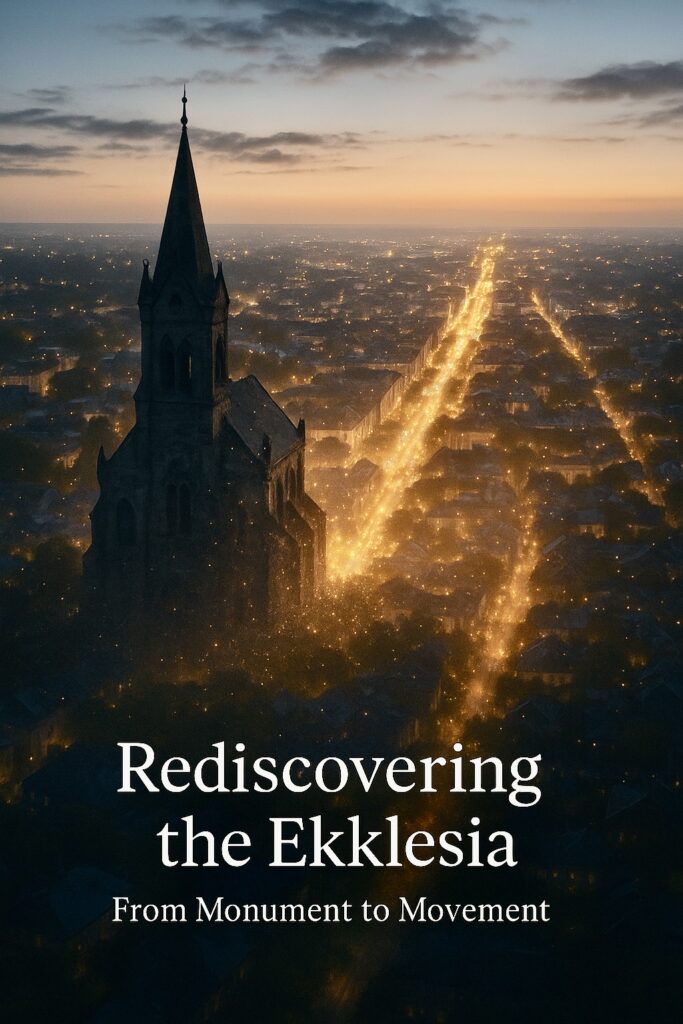
The movement became a monument.
And monuments don’t move.
Remember: The church doesn’t have a mission—God’s mission has a church.
We don’t go to church; we are sent as the church.
So here’s the shift we’re invited to make: to see the church not as a destination… but as a distribution center.
Every follower of Jesus is a royal priest somewhere:
A teacher shaping young minds, or a student mastering a subject — that’s ekklesia in the classroom.
A business owner leading with integrity, or an employee doing great work — that’s ekklesia in the marketplace.
A retiree praying over their neighborhood — that’s ekklesia in the cul-de-sac.
Every believer…
Every vocation…
Every corner of creation — is part of the field where God is working.
Run the Play
You are the church —
called out…
sent forth…
for the good of the world and the glory of God.
Finding Our Place in the Story
- Where have I reduced “church” to a location or event instead of living as part of God’s sent people?
- What does it look like to live as ekklesia in my daily environment—family, work, or neighborhood?
- How can our local church function more like a movement than a monument?

Leave a Reply