Running The Play Logo

Author: RTP/MJ

  • Taking Ground

    So Samuel did what the Lord told him, and he came to Bethlehem. Then the elders of the city came trembling to meet him and said, “Do you come in peace?” (1 Samuel 16:4 NASB)

    “Don’t make me come up there,” my dad would warn, his voice echoing through the dimly lit hallway as his four restless boys, wide-eyed and giggling, refused to settle down for the night. We knew we didn’t want to hear him coming up those stairs because he would not be coming in peace.

    I can vividly picture the scene in 1 Samuel 16-when Samuel arrived in your town, it likely meant you were in trouble with the Lord. (They had probably heard the chilling tales of what he did to King Agag of the Amalekites. 1 Samuel 15:32-33) It’s a lot like the warning our dad issued to us, filled with a mix of love and authority. We adored him, but the thought of him climbing the stairs to discipline us filled us with dread, making us think twice about our mischief.

    For the last few months, we’ve been studying 1 Samuel at our church, especially Israel’s battles with the Amalekites and Philistines. At the same time, I’ve been watching Amazon Prime’s new series, House of David, which doesn’t shy away from portraying the brutality of war. It’s reinforced the reality that spiritual warfare is just as real and fierce.

    At the climax of the battle between David and Goliath, the actor who plays David in the Amazon series is portrayed as praying one of the most powerful prayers we can say: “God, Give Me This Ground.” I’ve been leaning into this prayer more and more, especially as I become increasingly aware of the daily spiritual battle we face for taking and reclaiming ground for the Kingdom of God.

    Demonic powers quiver in fear at the sight of authentic followers of Jesus, fully aware that their reign is coming to an end. We do not arrive with gentle intentions; we march forward purposefully, determined to reclaim the ground the enemy has taken. Once a part of the Kingdom, this territory will soon be restored to the rightful King of the world, a proclamation of love, hope, and victory that echoes through the ages.

    Samuel commanded respect wherever he went because of the spiritual authority granted to him by Almighty God. Those young boys who were full of mischief and warned by their father to settle down finally did so not out of fear, but from a desire to obey and please their dad.

    By the power of his love, death, and resurrection, Jesus destroyed the works of the devil, conquered sin and death, and won all authority over heaven and earth. Authority and love he shares with his followers. As his apprentices, we take ground from the enemy with every divine appointment.

    Run The Play … with love, boldness, and authority.

    Finding Our Place in the Story

    Where do you see the battle lines being drawn in your community, and how might God be inviting you to advance His Kingdom there?

    What ground have you surrendered that God is now calling you to reclaim?

    How can you exercise spiritual authority with love and purpose in everyday spaces?

    Link to: House of David

  • Don’t Call it Ministry …

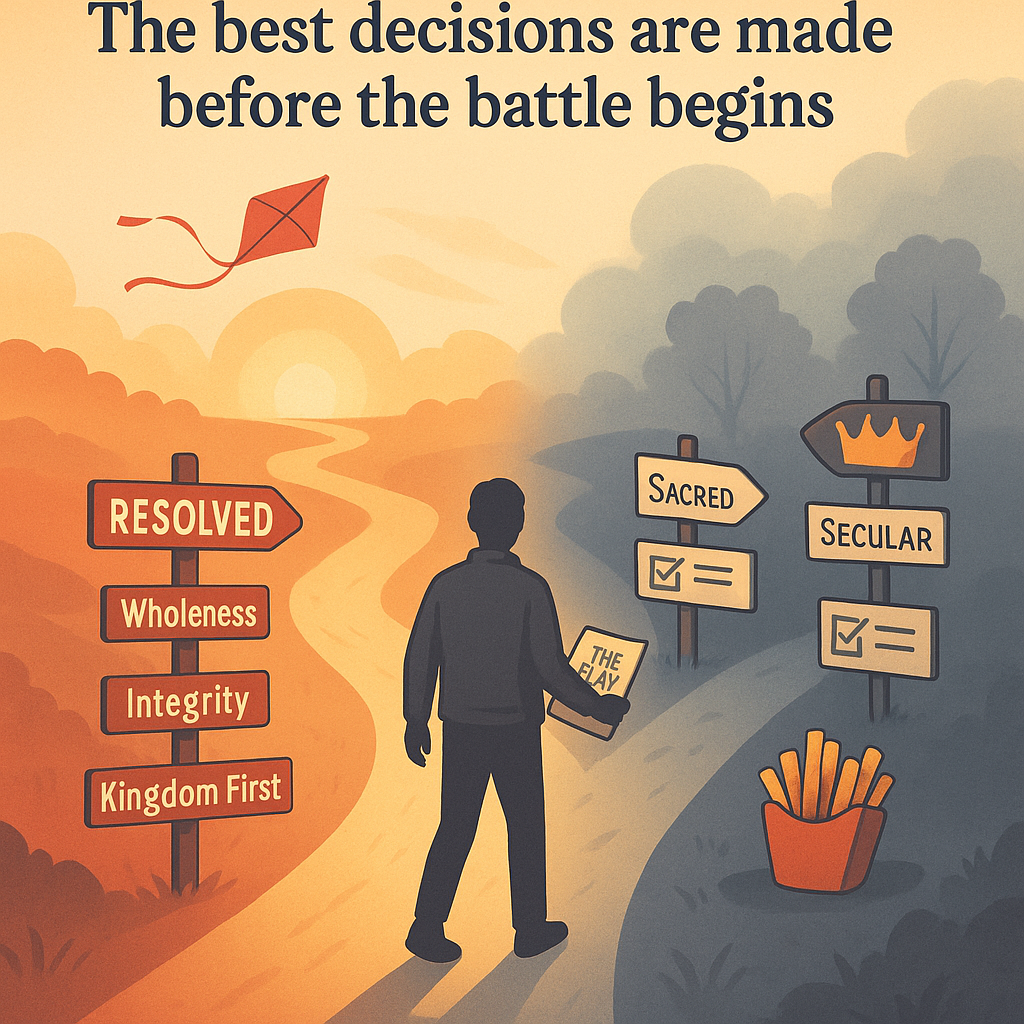
    One of the biggest obstacles to living the life we’ve always dreamed of is the cultural currents that promote the separation of the secular and the sacred. This is an obstacle to living our best life because it is not aligned with Biblical teachings. God is Lord over all, imbuing all of life with sacredness. The secular-sacred divide is a false dichotomy that leads to compartmentalized and fragmented lives. It’s a lie.  

    It might help to understand where this divide came from. These cultural currents have prevailed upon us for hundreds of years. Some historians believe they began during the Renaissance and Enlightenment in the 14th-18th Century. Separation became institutionalized in the 18th and 19th centuries, especially in Western Europe and America. 

    Our First Amendment, for example, speaks to the separation of church and state. The writers intended to protect the church from the state, not the state from the church. Philosophically, the sacred became a private, personal matter, while the secular ruled the public sphere.

    When I fell in love with Jesus and began following him, I longed for the abundant life he promised. To fully embrace that life, I realized I would need to leave my job and eventually commit to full-time ministry. That’s how the fish were swimming, so it made sense to enroll in seminary because that’s how a person became qualified for serious ministry. Perhaps you’ve experienced the same pressure to “go into ministry” to make a ‘real’ difference. There appeared to be different levels and expectations for followers of Jesus. No one said that to me, but as far as I could tell from how people behaved, that’s how Christianity worked. So, I tipped my toe into seminary night school to begin testing the waters.  

    But the entirety of Scripture paints a very different picture. The apostle Peter captured the arc of the Biblical story when he wrote about the priesthood of all believers. He was making a powerful statement about the identity and role of every Christian. This concept appears most clearly in 1 Peter 2:5 and 1 Peter 2:9:


    “You yourselves like living stones are being built up as a spiritual house, to be a holy priesthood, to offer spiritual sacrifices acceptable to God through Jesus Christ.” 1 Peter 2:5 (ESV)


    “But you are a chosen race, a royal priesthood, a holy nation, a people for his own possession, that you may proclaim the excellencies of him who called you out of darkness into his marvelous light.” 1 Peter 2:9 (ESV)

    Isn’t it fascinating that our Lord Jesus chose twelve men without theological training? Why would he choose followers who had no political influence? How many of them would fit the label of high net worth donor? That’s not how we typically choose leaders—in churches, non-profits, or the marketplace. For the Lord sees not as man sees: man looks on the outward appearance, but the Lord looks on the heart. (1 Samuel 16:7 (ESV)

    I’m not saying we don’t need seminaries, trained theologians, or full-time pastors—we do. But here’s where it gets personal. My friends, the truth is that ALL followers of Jesus are called into full-time ministry. All of life is sacred and overflowing with divine purpose. One of my favorite Bob Goff quotes captures this essence: “Don’t call it ministry; call it Tuesday.” 

    Your mission is to fulfill your purpose right where you are. You have everything you need. Work doesn’t give your life meaning; you bring meaning to your work. Wherever you go, the Kingdom of God has arrived … in you. 

    Run the play! 

    Finding Our Place in the Story
    Where in my life have I unintentionally bought into the lie that some work is more “spiritual” than others?

    What would it look like to incorporate sacred purpose into my everyday routines on a Tuesday, not just a Sunday?

    How might I live differently if I truly believed I was already a full-time minister of God’s Kingdom, right where I am?

    PS: Please add your thoughts in the comments section. Iron sharpens iron.

  • What is a good and Godly Day?

    Subscribe to continue reading

    Subscribe to get access to the rest of this post and other subscriber-only content.