Running The Play Logo

Author: RTP/MJ

  • Life in the Slow Lane

    “Be still and know that I am God.” – Psalm 46:10

    How many times have you passed the little old blue-haired lady on the Interstate with two hands gripped to the steering wheel, going 40 in a 70?

    I now have a new appreciation for her, because that’s what life feels like for me after hip replacement surgery.

    Hipster, hip hip hurray, hippie, Hip-Hop, and other derivatives have been making their way to my ears from the mouths of good-natured friends and family since my surgery on March 9th. I know their ribbing is just a cover-up for jealousy as I parade around with my new bionic appendage like a proud owner of a new car.

    The only thing better would be a touch of that “new car smell.” I’ll mention it to the surgeon.

    So far, all I’m sure of is that surgery is a journey, not an event.

    In addition to doing the research before deciding to move forward, there were a half-dozen pre-op hoops to jump through weeks before surgery. The post-op PTs kept reminding me that it would take 6–8 weeks for a full recovery. When I tried to negotiate the timeline, I was told it would be 6–8 weeks… even if I were 17 rather than 70.

    PTs don’t play fair or nice.

    As I write this, I’m exactly two weeks into the recovery, and by all accounts, things are going very well. Everything takes longer to do, and my day-to-day activities are greatly diminished… temporarily. My steps are slow and deliberate.

    And if I’m honest, that’s not just physically frustrating—it’s spiritually revealing.

    I’ve spent most of my life moving fast, getting things done, measuring progress. Slowing down feels like losing ground… even when I know it isn’t.

    As I walk, I remember my brothers, veterans of this procedure, saying, “Whatever you do, don’t fall.” I’m slow, and my leg wears down quickly.

    No spills so far!

    I remembered what the Psalmist said, “Be still and know that I am God.”

    “Be still” doesn’t necessarily mean slow down. It means stop striving.

    Psalm 46 emphasizes God as our refuge and strength, especially in times of trouble. It reminds us that even in the middle of chaos, we do not need to fear. God is present. God is powerful. Our focus shifts from our circumstances to His character.

    Psalm 46

    The operation may be over, but the surgery journey is not.

    “Be still and know that I am God” doesn’t mean “do nothing.” It means we do our part and trust God with His.

    Post-surgery, it means doing the PT work and trusting God for the outcome.

    The Lord is inviting us to stop living as if we are in control and instead focus on the work He has given us to do.

    We are in the obedience business.
    God is in the outcome business.

    Life is hard. Whatever circumstances you are navigating, you can trust God’s character.

    He is good.
    He is for you.
    He has not left.
    He will not change.

    Run the play. Be still and trust God.

    Put in the work… and let go of the outcome—and the timing.


    🧭 Finding Our Place in the Story

    Where in your life are you being forced to slow down—and what might God be revealing to you in that space?

    What does “doing your part” look like right now, and where might you be trying to control outcomes that belong to God?

  • Busted Brackets and Chasing the Wind

    “Time and chance happen to them all.” (Ecclesiastes 9:11)

    Ecclesiastes repeatedly pokes at humanity’s obsession with control.

    “The wise don’t bet their lives on vapor.”

    Spring has descended upon us, and there are two things we can depend on: severe thunderstorms and “March Madness.” One of them we’ve gotten reasonably good at predicting. The other—not so much. Both, however, have a way of exposing our illusion of control.

    March Madness is one of those cultural moments when the whole country becomes focused on the drama of college basketball. Each year millions of people fill out tournament brackets believing they’ve cracked the code—stats, matchups, expert picks, analytics.

    Then a 14-seed beats a 3-seed and the whole thing explodes by lunchtime.

    Bracket pools are a perfect metaphor for something that looks harmless on the surface but quietly reveals deeper heart dynamics. We think we’re predicting reality, but more often we’re just pretending we can control chance.

    I had a front-row seat to this same impulse during my years as a financial advisor. Clients routinely asked us to predict future stock market returns. Entire departments at major investment firms are devoted to the “science” of forecasting market performance.

    But after forty years in the industry, I can tell you something with confidence: when experts reach a strong consensus about what the market will do next, that consensus often becomes the least likely outcome.

    Like a busted bracket, the predictions fall apart.

    The Teacher in Ecclesiastes would have a word for this: chasing the wind.

    In recent years the gambling industry has discovered how profitable this human tendency can be. The expansion of sports betting in our country is breathtaking—and often destructive.

    A $10 office bracket may feel harmless. But modern sports-betting apps are carefully designed around dopamine loops:

    Small bets → near misses → chasing losses → bigger bets.

    This is not wisdom. It is vapor. And it is quietly destroying many lives and families.

    Whether we are watching sports or watching our investment portfolios, we must guard our hearts against the temptation to believe that enough knowledge, enough data, or enough confidence can allow us to control the future.

    We can’t.

    But the pursuit of control can certainly begin to control us.

    Interestingly, the Teacher of Ecclesiastes doesn’t leave us in despair. He offers a better way:

    “There is nothing better… than to eat and drink and find satisfaction in their toil.” (Ecclesiastes 2:24)

    Run-the-Play translation for March Madness:

    Enjoy the game.
    Laugh at busted brackets.
    Cheer for the Cinderella team.

    But don’t look to chance for meaning or security.

    We can build our lives on a solid foundation—the Rock of Ages—or we can spend our days grasping at the wind.

    March Madness reminds us how fragile our predictions really are. One buzzer-beater and the illusion of control disappears like vapor.

    Finding Our Place in the Story

    If your current “life bracket” were suddenly busted—plans changed, predictions failed, outcomes uncertain—what would remain steady in your life, and what might that reveal about where your true security rests?

  • Radical Kindness

    “I will bless those who bless you,
    and whoever curses you I will curse;
    and all peoples on earth will be blessed through you.”

    Genesis 12:3

    Many of us have been quietly discipled by Steve Hartman through his Kindness 101 stories—small, human moments that remind us it’s still good to be good. Those stories matter. They restore a little faith in humanity.
    But Scripture calls us beyond simple niceness into something deeper and more demanding—a radical kindness the Bible calls blessing. That’s not Kindness 101. That’s Kindness 401.

    From the beginning, God chose Abraham not as an endpoint but as a conduit: “all peoples on earth will be blessed” (Gen. 12:3). God narrows His redemptive focus to one family so His blessing might ultimately flow outward to the whole world. This has always been the missional calling of God’s people—we are blessed to be a blessing.

    In The True Story of the Whole World, Michael Goheen and Craig Bartholomew describe biblical blessing as the restoration of the “very good” God intended for creation. Blessing is God’s provision for human flourishing. But it is more than provision—it is relational. To be blessed by God is not only to receive His good gifts, but to know God Himself. Blessing restores both delight and direction.

    That’s why blessing can never be reduced to “just be kind”—though kindness certainly has its place. Being blessed to be a blessing means resisting retaliation, repaying evil with good, and actively working for the peace and flourishing of the places where God has planted us: our homes, neighborhoods, schools, workplaces, cities, and nations. Everywhere.

    As Nicky and Pippa Gumbel put it:

    To return evil for good is demonic.
    To return good for good is human.
    To return good for evil is the way of Jesus.

    Of course, this kind of radical kindness can feel naïve in a broken world. Saying the world is a mess hardly qualifies as breaking news. Ever since Eden, every generation has wondered whether things are getting worse instead of better. Yet one of the great comforts of Scripture is that the moral failures and character flaws of even the heroes of faith never derail God’s redemptive purposes.

    The Bible’s version of breaking news often comes down to two words: but God.

    There are roughly forty-five “but God” moments in Scripture, and each one marks a divine interruption—human failure, injustice, danger, even death… but God. Heaven’s favorite plot twist steps in and redefines the story:

    • “You meant evil against me, but God meant it for good” (Gen. 50:20)
    • “We were dead in our trespasses… but God, being rich in mercy” (Eph. 2:4)
    • “They tried to kill Him… but God raised Him from the dead” (Acts 13:30)

    If Kindness 101 is about nice human actions, Kindness 401 is about being blessed to be a blessing—those “but God” moments when divine kindness breaks in through ordinary people. It’s a graduate-level kindness that leads to real human flourishing, and it only happens in partnership with God.

    Run the play.
    Be a conduit of blessing.
    Let radical kindness interrupt the story.

    Finding Our Place in the Story

    (Kindness 401 Edition)

    Where might God be inviting me to move beyond being “nice” and instead become a conduit of blessing—even if it costs me comfort, control, or credit?
    (Think people, places, or tensions you’d rather avoid.)

    What does it look like, practically, for me to repay evil with good in my current season of life?
    (At home, work, church, neighborhood—where is radical kindness most needed?)

    Can I identify a recent or hoped-for “but God” moment where divine interruption—not human effort—redefined the story?
    (How might God want to use me as part of that interruption for someone else?

  • Collateral Beauty

    He, for the joy [of obtaining the prize] that was set before Him, endured the cross, despising and ignoring the shame, and is now seated at the right hand of the throne of God..”
    Hebrews 12:2 (AMPC)

    The cross didn’t look like victory.

    “Collateral beauty.”
    Wait—don’t you mean collateral damage?

    As part of our church’s study of 1 Peter, our friend Karen wrote on our collective Bible study blog:

    “My prayer is that our church would not be surprised by suffering and would not move away from God in distrust because of suffering, but would rather embrace it as a conduit to His collateral beauty that only suffering can accomplish.”

    We don’t naturally associate suffering with beauty. And yet, her words rang true. In our own lives, suffering has shaped and gifted us in ways we never could have imagined. We’ve all heard people who emerge from seasons of hardship say, “I wouldn’t change it for the world.”

    That’s collateral beauty—the realization that removing the “bad” parts of our history would also erase the “good” parts of our present.

    Joni Eareckson Tada offers a powerful example. Paralyzed from the neck down as a teenager, she endured years of what she described as a “dark night of the soul.” Yet she eventually came to a startling conclusion: her suffering was the very thing that made her life beautiful. Today, she is a celebrated author and advocate who views her wheelchair not as a prison, but as a platform.

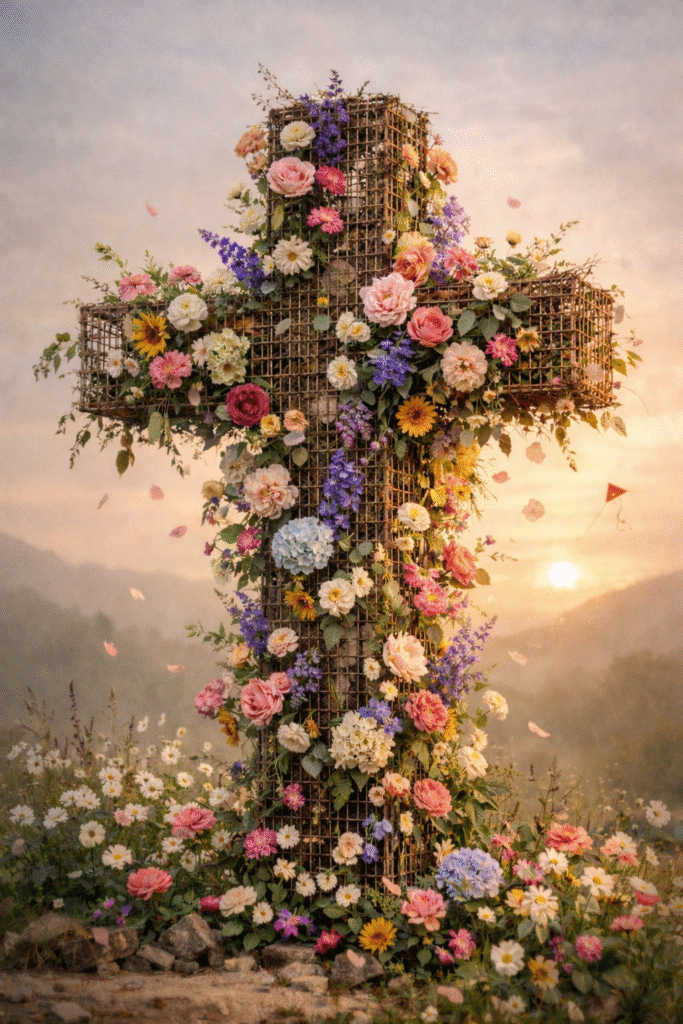
    Collateral beauty also comes to mind when I think of one of our favorite Easter traditions from our years in Charlotte—the flowering of the cross on Resurrection Sunday. Each person brought a fresh-cut flower from home, and during the opening procession, the flowers were placed into a wire mesh cross. Slowly, an ugly instrument of torture and death was transformed into something profoundly beautiful. It became a living testimony of how Jesus’ sacrifice and resurrection turned catastrophe into triumph.

    “To find Jesus in your hell is ecstasy beyond compare and I wouldn’t trade it for any amount of walking in this world.” – Joni Eareckson Tada

    In the shadow of that flowered cross, the truth of Hebrews 12:2 takes shape. Jesus endured the cross for the joy set before Him—the joy of freedom, restoration, and renewal purchased for all of creation.

    Collateral beauty, indeed.

    If the apostle Peter’s first letter were condensed into a single message, it might sound like this: suffering is not failure, obedience is not wasted, and the risen Christ is not distant. He is present, victorious, and forming a people who live with courage, clarity, and hope.

    It’s Joni’s testimony.
    It’s Peter’s message.
    And it’s good news for all who are weary and hard-pressed.

    When life gets tough and you feel like giving up, keep your eyes on Jesus—and run the next play.

    🧠 Finding Our Place in the Story

    Where have you experienced beauty in your life that only became visible through suffering rather than around it?

    Are there parts of your story you’re tempted to wish away that God may be using to form something redemptive in you right now?

    How might Jesus be inviting you to keep running the next play—trusting that obedience is not wasted, even when the outcome is unclear?

  • Invisible Fence of the Soul

    “The thief’s purpose is to steal and kill and destroy. My purpose is to give them a rich and satisfying life.”
    — John 10:10 (NLT)

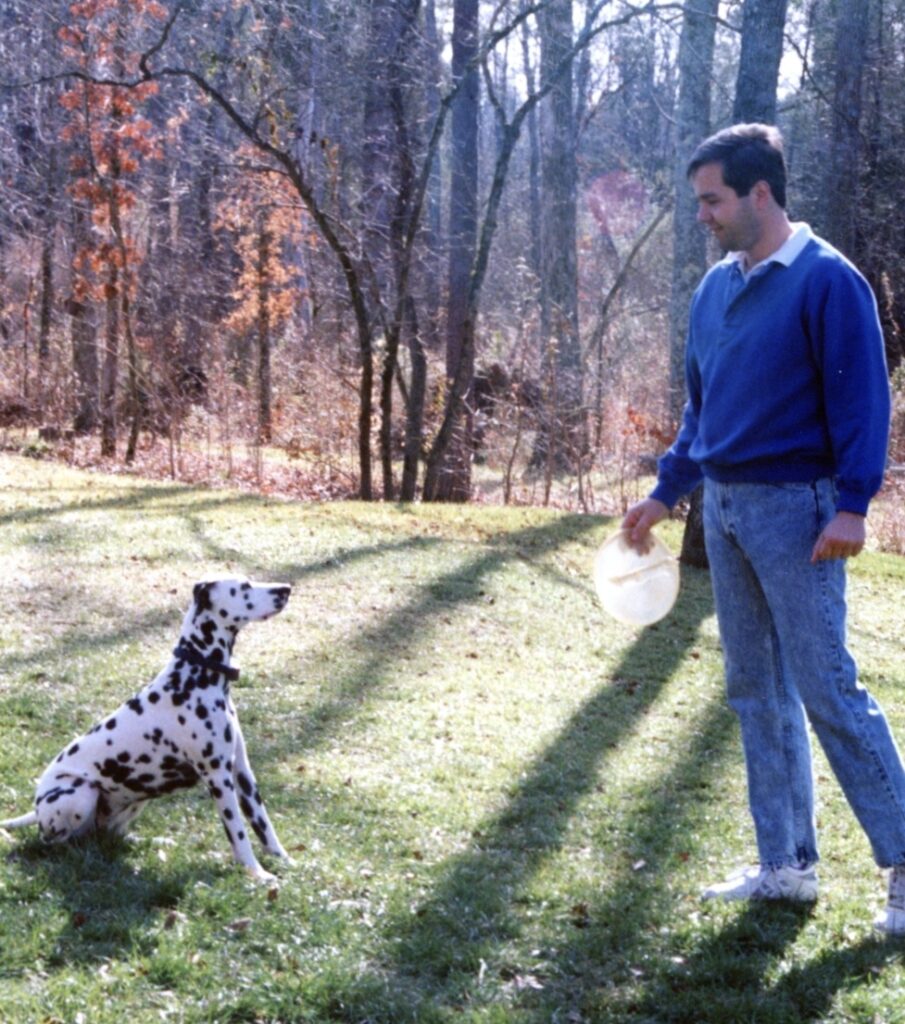
    Our first family dog was a Dalmatian we named Oreo. She was a cute puppy, had the energy of five dogs, and was smart enough to teach herself how to open our back door. (I had to teach her how to close it. 😀)
    We chose an invisible fence as the solution for keeping her in our yard, and she learned the established boundaries quickly.

    An invisible fence is a hidden boundary buried underground that sends a warning signal to a dog’s collar as they approach the edge—first a beep, then a mild correction—teaching them where freedom ends without ever building a physical barrier. Think of it as freedom with guardrails: no walls, no gates, just a quiet, consistent reminder that keeps a dog safely home while convincing them the yard ends exactly where it should.

    Reading, studying, and obeying Scripture is like an invisible fence for the soul. It’s one of the ways God extends freedom to us—with guardrails. When we stay inside those boundaries, we experience the rich and satisfying life He desires for us. Outside the guardrails of Scripture are the very things that harm the soul—the things our loving Father wants to protect us from.

    The enemy of our souls is the thief Jesus warns us about in John 10:10—one who desires to steal, kill, and destroy us in this life and the next. He is a liar, an expert in deception, constantly trying to convince us that bad is good and good is bad. From the time of Adam and Eve, he has made attractive the very things that are deadly.

    “Like gravity, God’s laws are in effect regardless of our personal knowledge, belief, or consent.”

    A personal devil is not a popular construct in modern times. Pride can blind us to the danger that lurks beyond the guardrails of God’s immutable laws. Our loving God gives us the freedom to choose life or death—but make no mistake: like a good parent, His heart grieves when we choose to live outside freedom’s boundaries.

    Like gravity, God’s laws are in effect regardless of our personal knowledge, belief, or consent. Biblical ignorance, along with intentional disobedience, is like living life without guardrails—the invisible fence of freedom removed. These are two sides of the enemy’s currency, which always trades in bondage—the original form of human trafficking.

    Run the play… inside the rails.

    Read, study, and follow the playbook. (The Bible.)
    Enjoy your freedom.


    Finding Our Place in the Story

    • Where in my life am I most tempted to test or ignore God’s guardrails—and what story am I telling myself to justify it?
    • How have I experienced God’s boundaries not as restriction, but as protection and freedom in the past?
    • What practices could help me stay more attentive to the “warning beeps” of Scripture, conscience, and the Spirit before I cross a boundary?

  • Olympic Hurling

    “They kept demanding an answer, so he stood up again and said, ‘All right, hurl the stones at her until she dies. But only he who never sinned may throw the first!’” – John 8:7

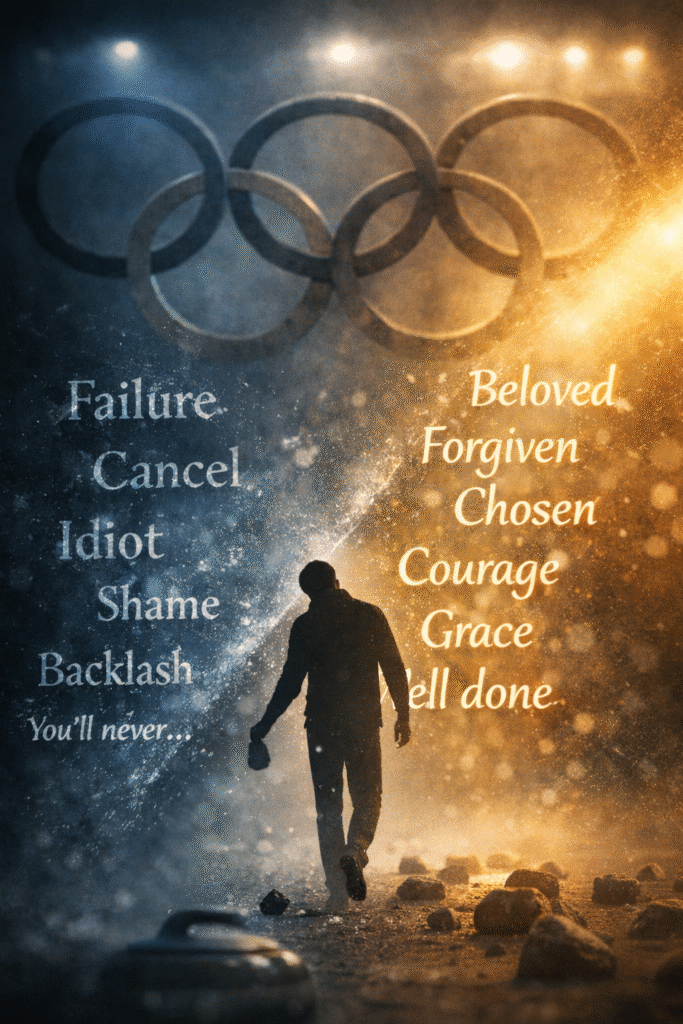
    Thanks to the Winter Olympics, I’ve got stone throwing on my mind.

    Every four years we are reintroduced to the sport of curling, where athletes slide 44-pound granite stones toward a target 126 feet away. The player creates a curved trajectory—known as the “curl”—by gently rotating the stone as it leaves the hand. For a sport dating back to 16th-century Scotland, it still hasn’t found massive appeal. At least the Scots have golf.

    Unfortunately, the sport of hurling insults, condemnation, and criticism has found mass appeal.

    Judging by the national mood, there is huge demand for it. I call it a “sport” because the words we throw at one another feel like a competition—opposing teams fighting for the illusion of supremacy … the last word, the win. Ironically, there are no winners, no gain, and everyone loses.

    Every day headlines feature words like battle, rip, backlash, slam, accuse, revenge. And that’s just ESPN. The fiercest hurling is usually saved for the front and opinion pages.

    Remember when we used to say, “Sticks and stones can break my bones, but words can never harm me”?

    It was playground armor. Say it fast enough and confidently enough, and maybe you’d convince yourself the sting didn’t land.

    But here’s the thing.

    It’s catchy.
    It’s punchy.
    It’s not true.

    Modern psychology and ancient Scripture agree: words absolutely harm.

    Neuroscience shows that verbal rejection activates the same pain centers in the brain as physical injury. Long before brain scans, Proverbs told us, “The tongue has the power of life and death” (Prov. 18:21). James compares it to a spark that can set a forest ablaze (James 3).

    And Jesus raises the stakes even higher. In Matthew 12:36, He says we will give account for every careless word. That isn’t meant to silence us. It’s meant to awaken us to influence.

    When the Pharisees dragged the woman caught in adultery before Him, they were hurling more than stones. They were hurling accusation, condemnation, and hypocrisy. The prescribed punishment was death by stoning. Seeing what they could not see in themselves, Jesus invited anyone without sin to throw first.

    One by one, beginning with the oldest, they dropped their rocks and walked away.

    Words can wound.

    But they can also heal.
    They build.
    They commission.
    They restore.
    They declare ground taken or surrendered.

    Run the play.
    Drop the rocks.
    Let’s hurl words that create life.

    Now that’s an Olympic sport we can all pick up and play.

    Finding Our Place in the Story

    Where in my life am I tempted to hurl criticism, sarcasm, or condemnation instead of extending mercy and truth?

    • Is there a relationship where I keep reaching for a stone?

    If my words over the past week were replayed publicly, would they create life or quietly chip away at it?

    • Where might the Lord be inviting me to use my voice to heal, build, or restore instead?

    What kind of “sport” are we modeling as a church — one of hurling or one of healing?

    • How can we intentionally cultivate a community where life-giving words are the norm and rocks are left on the ground?
  • Reverse Aging

    He is the one we proclaim, admonishing and teaching everyone with all wisdom, so that we may present everyone fully mature in Christ. – Colossians 1:28

    My mom used to say, “Getting older isn’t for sissies.” I used to laugh when people said that. I don’t anymore.

    I’ve been active most of my life, but lately pain in my right leg after exercise sent me looking for medical advice beyond the internet and the locker room. After reviewing the X-rays, the doctor gave me the diagnosis: OA.

    My wife Sharon’s twin sister, Karon, asked, “What’s OA? Old Age?”

    OsteoArthritis may be the latest thing, but it’s not the only thing — and it certainly won’t be the last. The truth is, our physical (and eventually mental) health is on an irreversible downhill trajectory. Each morning, Sharon and I thank God for our health — what’s left of it. It’s precious to us, and we’re grateful.

    We’re especially thankful that we are not our bodies.

    Scripture calls them “jars of clay.” Temporary. Fragile. Useful — but not eternal.

    Peter and Paul both remind us that we are spiritual beings living in temporary tents. Even as our bodies decay and occasionally betray us, something else is happening. We are being transformed — steadily, quietly — into the likeness of Christ (2 Corinthians 5; 2 Peter 1:13).

    James goes even further. He tells us to consider it pure joy when we face trials, because the testing of our faith produces perseverance — and perseverance is essential for maturity (James 1:2–4).

    In other words, even as our bodies decline, the eternal us can be getting better and better.

    Jesus once told His disciples that anyone who does not receive the kingdom of God like a little child will never enter it (Luke 18:16–17). Strangely enough, as we mature in Christ, our faith becomes more childlike, not less:

    • A child has not lost their sense of wonder
    • A child’s life is founded on trust
    • A child’s instinct is obedience
    • A child forgives quickly
    • A child loves deeply — and receives love freely

    This is not regression. It’s redemption.

    Don’t be fooled by modern promises of reversing aging through prescriptions, procedures, or potions. That’s a fool’s errand. Our calling is to invest in the part of us that will outlive our bodies’ usefulness.

    A mature, childlike faith is the one true way to reverse aging.

    Run the Play. Invest in the eternal you.


    Finding Our Place in the Story

    1. Where am I grieving losses connected to aging — and how honestly am I bringing that grief to God?
    2. In what ways might God be using physical limitations to deepen my trust, wonder, or obedience?
    3. As a community, how can we honor aging not as decline alone, but as spiritual formation in progress?
  • Choose Love

    Above all, love each other deeply, because love covers over a multitude of sins. —1 Peter 4:8

    During the NFL divisional playoffs—and again in the Super Bowl—the league honored Dr. Martin Luther King Jr. by displaying the words “Choose Love” in the end zones and on helmet decals.

    It’s not easy being a Buffalo Bills fan. Bills Mafia, as they’ve become known, suffer from perennial heartbreak, as each year their beloved Bills find new and creative ways to snatch defeat from the jaws of victory. And yet, the people of Buffalo keep showing up. They keep believing. They keep loving their team. In that sense, love covers a multitude of past failures.

    When the apostle Peter wrote that love covers a multitude of sins, he wasn’t thinking about sports. He was highlighting love’s redemptive and relational power.

    Human love doesn’t atone for sin—only God does that. And Peter isn’t sneaking works-based forgiveness in through the side door like a theological raccoon. He is urging followers of Jesus to cultivate healthy, trust-filled relationships with one another.

    Stephen Covey illustrated this idea with his metaphor of the emotional bank account. It represents the level of trust in a relationship. Acts of kindness, honesty, and faithfulness are deposits that build trust. Disrespect, broken promises, and selfishness are withdrawals that deplete it.

    This image helps us understand capacity. Loving one another deeply means building enough trust and grace that when sin happens (and it will, because we’re human), it doesn’t immediately bankrupt the relationship.

    “Love covers a multitude of sins” does not mean:

    • pretending sin isn’t sin
    • excusing harm
    • keeping score so we can rehash it later

    It does mean:

    • refusing to let every failure or disagreement become a rupture
    • choosing patience over retaliation
    • absorbing small offenses so the relationship doesn’t fracture

    In that sense, love covers our brokenness the way a roof covers a house—not by denying storms exist, but by keeping them from destroying what’s underneath.

    “Love does not delight in evil but rejoices with the truth. It always protects, always trusts, always hopes, always perseveres. Love never fails.”
    —1 Corinthians 13

    There’s been a lot of emotional hand-wringing over the divisions in our culture. The fractures are real—but they’re not new. Dr. King understood what heals deep wounds. So did Abraham Lincoln. The answer then is the same now: choosing to love others by seeking the peace and prosperity of the people and places where we live.

    That’s how trust is rebuilt.
    That’s how capacity is restored.
    That’s how relationships endure.

    When the pressure is highest and the hit is coming, the play call still stands:

    Choose love.

    🧠 Finding Our Place in the Story

    Where has a relationship in your life been strained by repeated disappointments—and what might it look like to rebuild trust instead of walking away?

    Are there any “small offenses” you’re holding onto that love may be inviting you to absorb rather than escalate?

    What would it look like for you to choose love in one concrete situation this week—especially where it feels costly?

  • Hump Day

    Set your minds on things above, not on earthly things.Colossians 3:2 NIV

    Sometimes January feels like it will never end.

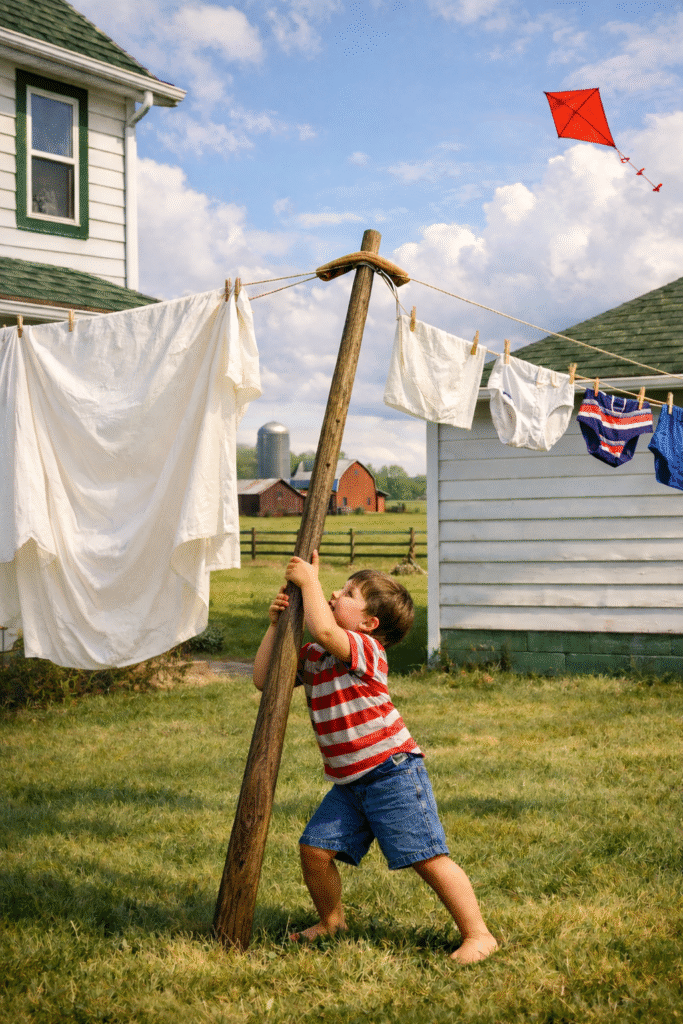
    Before there were solar panels, wind turbines, and automatic washers and dryers, there were clotheslines. Our mom would hang out the laundry to dry by sun and wind. And when her boys were especially mischievous, she’d tell us to go outside and “blow on the clothes.”

    One of our key responsibilities was inserting the clothes pole—strategically placed in the middle of the line—to keep the clean laundry from sagging into the dirt. That pole didn’t remove the weight of the wet clothes; it lifted them just enough to keep them clean and moving toward home.

    That’s what the Running the Play blog is meant to be.

    We publish on Wednesdays on purpose—as a midweek reset, a way to lift our hearts and minds back toward the things that matter most. It’s hump day for the soul. Like that clothes pole, these posts aim to elevate the spirit and help us finish the week strong.

    So much of life requires mental toughness, and following Jesus is not a hall pass to an easy life. In many ways, it gets harder. The apostle Paul compared the life of faith to running a race (Galatians 2:2; 2 Timothy 4:7).

    Marathon runners will tell you the hardest miles aren’t the first ones—or even the last. It’s the middle miles that test you most. The excitement of the start has faded. The finish still feels far away. You’re no longer running on adrenaline—just resolve.

    At that point, the race becomes a decision, not a distance.

    Runners say this is where it stops being about training and starts being about choosing to keep going. One mile at a time. One step at a time. No heroics—just faithfulness. Nothing is technically wrong… but everything feels wrong. You’re not injured. You’re not lost. You’re just tired. And that’s what makes it dangerous.

    The good news is there is an antidote for the midweek—and mid-January—blahs.

    It’s a decision.

    Like the mentally tough long-distance runner, we choose to keep going—knowing we are surrounded by a great cloud of witnesses, throwing off everything that hinders and the sin that so easily entangles, and running with perseverance the race marked out for us. We fix our eyes on Jesus, the pioneer and perfecter of our faith (Hebrews 12:1–2).

    That clothes pole didn’t remove the weight of the laundry—it lifted it just enough.
    Same with a midweek word.
    Same with faith.
    Same with endurance.

    Let’s keep running the play… one well-placed pole at a time. Fix your eyes on Jesus.

    And just in case you were wondering… January ends in three days.


    Finding Our Place in the Story

    Where do you currently feel like you’re in the “middle miles” of life—past the excitement, not yet at the finish—and tempted to lose resolve?

    What practices help you “lift your eyes” midweek and re-orient your heart toward things above rather than what’s weighing you down?

    What might it look like this week to choose faithfulness over heroics—one step, one decision, one mile at a time?

  • Loneliness

    “Come near to God and he will come near to you.” — James 4:8

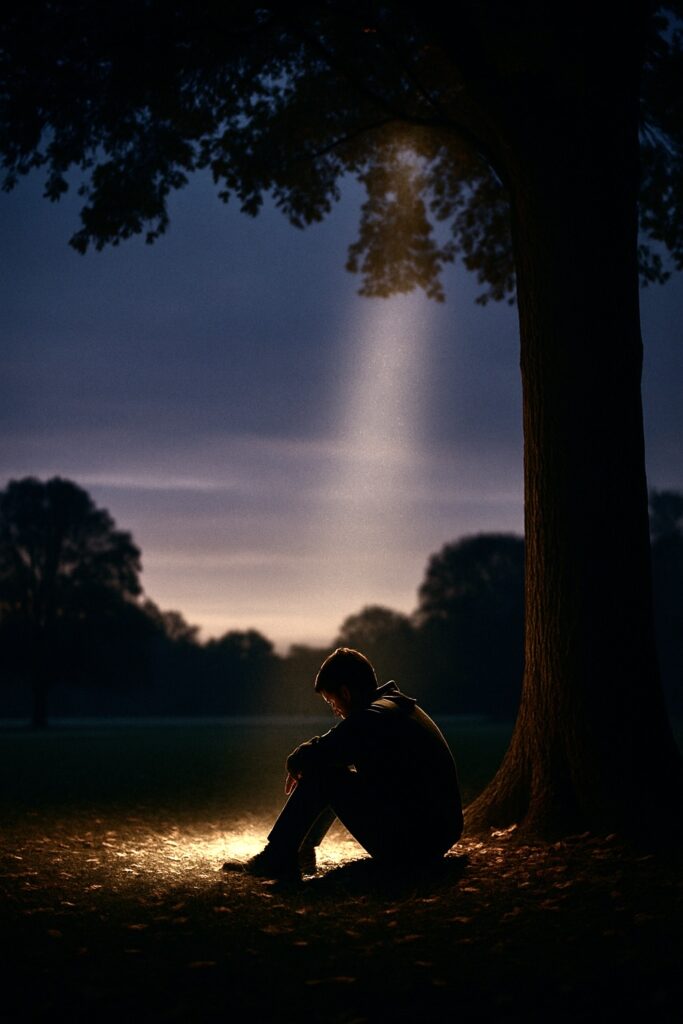
    Sunday nights were the worst. When I was single, living on my own, and fumbling through the whole adulting thing, loneliness was an unwelcome and persistent companion. On many dark Sunday nights, when those heavy feelings settled in, I’d get in my car and drive to a favorite park. Under a grand old tree, I’d sit and search for a peace I couldn’t manufacture. Often in tears, I cried out to a God I didn’t really know—for help, for relief, for something.

    I kept returning to that spot because, somehow, I felt closer to Him there. I felt heard. And thankfully, the ache of Sunday nights usually surrendered to the distraction of Monday mornings, where the noise of life smothered the loneliness for a while.

    Our church just finished a study of the book of James. James—the brother of Jesus—never pulled his punches. His letter reads like a collection of proverbs that hit hard. But when we read it through the lens of a loving spiritual father, we see his true intention: he wants his spiritual family to flourish. He echoes the themes of his big Brother’s Sermon on the Mount, unpacking the keys to an abundant life with surprising tenderness.

    Because of the punchy, proverbial style, it’s easy to miss the breathtaking promises woven through the book. James 4:8 is one of them. I was stunned again by its simplicity: When we draw near to God, He will draw near to us. Not might. Not occasionally. He will. Said another way, God is irresistibly drawn to anyone who genuinely wants to be with Him.

    Jeremiah echoed the same promise centuries earlier: “You will seek me and find me when you seek me with all your heart.” (Jer. 29:13) These words were spoken to exiles who felt abandoned and forgotten in Babylon. God assured them He had not let them go. He invited them to seek Him wholeheartedly, promising that He would be found and that He would restore them. And He kept that promise.

    Our modern exile didn’t come from Babylon—it came from COVID. Its damage went far beyond physical suffering. The isolation it unleashed still ripples through our world. We are relational beings, created in the image of a relational God. We need one another. And even more, we need Him.

    In ancient Israel, that truth took physical form in the tabernacle—the dwelling place of God among His people. A mobile sanctuary where heaven brushed earth, reminding Israel that the Holy One was not distant or abstract but present in their very midst. In our day, He tabernacles with us by His Spirit who resides in every follower of Jesus. Immanuel—God with us.

    The young man under that tree all those years ago—crying out to a God he didn’t really know—was already being met by the God who knew him completely. I was living out a promise I’d never heard: when we draw near to Him, He always draws near to us. It’s not a feeling; it’s a fact. His nearness is covenantal, not circumstantial.

    Run the play.
    Seek Him with all your heart.
    Immanuel—God with us.


    Finding Our Place in the Story

    1. Where are the “Sunday night places” in your own life—the moments or spaces where loneliness, fear, or uncertainty still surface—and what would it look like to bring those places honestly before God?
    2. James promises that when we draw near to God, He draws near to us. What is one practical way this week you can take a single step toward Him, trusting that He is already moving toward you?
    3. In seasons that feel like exile—disconnected, isolated, or unseen—how might remembering Immanuel, God with us reshape your sense of belonging and hope?
    4. Who around you might be experiencing their own “Sunday night loneliness,” and how could you embody God’s nearness to them in a simple, tangible way this week?